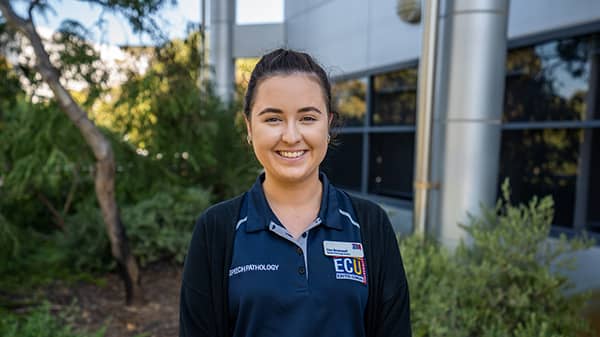
We're ranked one of the world's best universities under 50 years old, and we've already established a global reputation for such a young institution.
Toggle between study options for Domestic or International students
About this Course
If you are passionate about communicating, and have an interest in helping people across the lifespan, this might be a career for you.
Speech pathologists provide diagnostic assessment and management of disorders of communication and swallowing for people of all ages, from babies to older populations. Speech pathologists support people through direct therapy interventions, education, consultancy, advocacy, or a combination of these approaches. One of the best things about studying Speech Pathology at ECU is starting your practical experience in your first year. And with our smaller student cohort and greater personal attention you’ll receive from our experienced lecturers, it’s the best way to start your new career.
If you are passionate about communicating, and have an interest in helping people across the lifespan, this might be a career for you.
Speech pathologists provide diagnostic assessment and management of disorders of communication and swallowing for people of all ages, from babies to older populations. Speech pathologists support people through direct therapy interventions, education, consultancy, advocacy, or a combination of these approaches. One of the best things about studying Speech Pathology at ECU is starting your practical experience in your first year. And with our smaller student cohort and greater personal attention you’ll receive from our experienced lecturers, it’s the best way to start your new career.
Admission requirements you'll need to meet for this course.
All applicants must meet the academic admission requirements for this course. The indicative or guaranteed ATAR is as published (where applicable) or academic admission requirements may be satisfied through completion of one of the following:
AQF Diploma or equivalent;
Undergraduate Certificate;
Successfully completed 0.5 EFTSL of study at bachelor level or higher at an Australian higher education provider (or equivalent);
International students and internationally schooled applicants (other than those students schooled in a recognised country) are required to provide an English language test approved by ECU with a score equivalent to the following minimum requirements:
IELTS Academic with a minimum overall score of 7.5 (with no individual band score less than 7.0), or
Pearson English Test (PTE) Academic with a minimum overall score of 72 and a minimum score of 65 in each of the four communicative skills (listening, reading, writing and speaking).
Note:
English tests must be completed within 2 years of the proposed course commencement date and additional requirements may apply in relation to acceptable number of test sittings. TOEFL iBT is not accepted from 26/07/23. Recognised countries for English language purposes are Australia, Canada, New Zealand, Republic of Ireland, South Africa, United Kingdom or the United States of America. The medium of instruction must be English.
Minimum English standard requirements for this course may also be satisfied with one of the following:
Year 12 English ATAR/English Literature ATAR grade C or better or equivalent;
Skills for Tertiary Admissions Test;*
Successfully completed 1.0 EFTSL of study at bachelor level or higher in the UK, Ireland, USA, NZ or Canada;
University Preparation Course;
Indigenous University Orientation Course;*
Aboriginal Student Intake Test;*
AQF Diploma, Advanced Diploma or Associate Degree; or
Successfully completed 0.375 EFTSL of study at bachelor level or higher at an Australian higher education provider (or equivalent).
Applications for this course are not accepted through ECU's Experience Based Entry Scheme.
Course Entry
Admission requirements you'll need to meet for this course.
All applicants must meet the academic admission requirements for this course. The indicative or guaranteed ATAR is as published (where applicable) or academic admission requirements may be satisfied through completion of one of the following:
AQF Diploma or equivalent;
Undergraduate Certificate;
Successfully completed 0.5 EFTSL of study at bachelor level or higher at an Australian higher education provider (or equivalent);
International students and internationally schooled applicants (other than those students schooled in a recognised country) are required to provide an English language test approved by ECU with a score equivalent to the following minimum requirements:
IELTS Academic with a minimum overall score of 7.5 (with no individual band score less than 7.0), or
Pearson English Test (PTE) Academic with a minimum overall score of 72 and a minimum score of 65 in each of the four communicative skills (listening, reading, writing and speaking).
Note:
English tests must be completed within 2 years of the proposed course commencement date and additional requirements may apply in relation to acceptable number of test sittings. TOEFL iBT is not accepted from 26/07/23. Recognised countries for English language purposes are Australia, Canada, New Zealand, Republic of Ireland, South Africa, United Kingdom or the United States of America. The medium of instruction must be English.
Minimum English standard requirements for this course may also be satisfied with one of the following:
Year 12 English ATAR/English Literature ATAR grade C or better or equivalent;
Skills for Tertiary Admissions Test;*
Successfully completed 1.0 EFTSL of study at bachelor level or higher in the UK, Ireland, USA, NZ or Canada;
University Preparation Course;
Indigenous University Orientation Course;*
Aboriginal Student Intake Test;*
AQF Diploma, Advanced Diploma or Associate Degree; or
Successfully completed 0.375 EFTSL of study at bachelor level or higher at an Australian higher education provider (or equivalent).
Applications for this course are not accepted through ECU's Experience Based Entry Scheme.
Note: SPE2103 should be completed concurrently with SPE2205. If the units are undertaken in different semesters, SPE2103 should be completed before enrolling into SPE2205.
Language Difference: Implications for Clinical Practice
15
Note: SPE3128 and SPE3106 should be completed concurrently with SPE3107. If units are undertaken in different semesters, SPE3128 and/or SPE3106 should be completed before enrolling into SPE3107.
Students are required to complete substantial clinical practicums designed to provide the required range of clinical experience. Fieldwork placements commence in the first year and throughout the course, and provide students with valuable learning experiences in a range of settings.
To be eligible to undertake clinical practice and fulfil their duty of care, students are required to complete pre-practicum preparation on commencement of the course and carry out amendments in subsequent semesters, as appropriate. For more information, see course details on our website. Due to the practical nature of the Speech Pathology professions and protection of the public, there are inherent requirements applicable to this course that may impact upon the success of some potential students. Applicants and students with a disability or other issue likely to impact on their ability to perform in practice are encouraged to contact the Access and Inclusion Service to discuss their situation. More information can be found at https://www.ecu.edu.au/schools/medical-and-health-sciences/placements/inherent-requirements
Course learning outcomes
Apply broad discipline knowledge and theory to a range of speech pathology contexts.
Think critically to analyse, interpret and conceptualise complex communication and swallowing conditions.
Think creatively to anticipate challenges and generate solutions in complex speech pathology contexts.
Use digital technologies to access and evaluate information and to enhance speech pathology practice.
Communicate knowledge and ideas clearly, coherently and with independence.
Demonstrate a global outlook with respect for cultural diversity, including developing capabilities in delivering culturally secure services for Aboriginal and Torres Strait Islander individuals, families and communities.
Work collaboratively to initiate social, sustainable and ethical practices to achieve positive client outcomes.
Demonstrate autonomy, accountability and self-awareness for own learning.
Note: SPE2103 should be completed concurrently with SPE2205. If the units are undertaken in different semesters, SPE2103 should be completed before enrolling into SPE2205.
Language Difference: Implications for Clinical Practice
15
Note: SPE3128 and SPE3106 should be completed concurrently with SPE3107. If units are undertaken in different semesters, SPE3128 and/or SPE3106 should be completed before enrolling into SPE3107.
Students are required to complete substantial clinical practicums designed to provide the required range of clinical experience. Fieldwork placements commence in the first year and throughout the course, and provide students with valuable learning experiences in a range of settings.
To be eligible to undertake clinical practice and fulfil their duty of care, students are required to complete pre-practicum preparation on commencement of the course and carry out amendments in subsequent semesters, as appropriate. For more information, see course details on our website. Due to the practical nature of the Speech Pathology professions and protection of the public, there are inherent requirements applicable to this course that may impact upon the success of some potential students. Applicants and students with a disability or other issue likely to impact on their ability to perform in practice are encouraged to contact the Access and Inclusion Service to discuss their situation. More information can be found at https://www.ecu.edu.au/schools/medical-and-health-sciences/placements/inherent-requirements
Course learning outcomes
Apply broad discipline knowledge and theory to a range of speech pathology contexts.
Think critically to analyse, interpret and conceptualise complex communication and swallowing conditions.
Think creatively to anticipate challenges and generate solutions in complex speech pathology contexts.
Use digital technologies to access and evaluate information and to enhance speech pathology practice.
Communicate knowledge and ideas clearly, coherently and with independence.
Demonstrate a global outlook with respect for cultural diversity, including developing capabilities in delivering culturally secure services for Aboriginal and Torres Strait Islander individuals, families and communities.
Work collaboratively to initiate social, sustainable and ethical practices to achieve positive client outcomes.
Demonstrate autonomy, accountability and self-awareness for own learning.
1 The 'estimated 1st year indicative fee' is provided as a guide only, based on a typical enrolment of students undertaking the first year of this course. At ECU, you pay for the individual units you enrol in, not an overall course fee, so the total cost of your course will vary, depending on what units you choose. An indicative fee will be provided with your course offer, however you can use our Course Fee Calculator to estimate the actual amount you'll need to pay. ECU fees are adjusted annually.
Some units require the payment of a fee for incidental goods or services required to complete those units. For more information and the full list of incidental fees for courses and units, visit What are Incidental Fees.
Scholarships
ECU has a scholarship program that provides many opportunities each year to students undertaking studies here.
Speech pathologists are employed in child development centres, schools, hospitals, private practice, disability organisations, in the performing arts, or in universities.
Possible future job titles
Speech Pathologist
Courses you can consider if you are interested in progressing further in this area.
Bachelor of Speech Pathology Honours Students who have a Weighted Average Mark (WAM) of 70 per cent or higher across the first three years of their Bachelor course may be invited to enrol in the Honours program. Students will need to transfer into the Honours course prior to commencing.
Fees and Scholarships
Fees
AUD $46,000 - International students estimated 1st year indicative fee 1
Note
1 The 'estimated 1st year indicative fee' is provided as a guide only, and has been calculated based on a typical enrolment of students undertaking the first year of this course. At ECU, you pay for each individual unit you enrol in, not an overall course fee, so the total cost of your course will vary, depending on what units you choose. An indicative fee will be provided with your course offer, however you can use our Course Fee Calculator to estimate the actual amount you'll need to pay. ECU fees are adjusted annually.
Some units require the payment of a fee for incidental goods or services required to complete those units. For more information and the full list of incidental fees for courses and units, visit What are Incidental Fees.
Scholarships
ECU has a scholarship program that provides many opportunities each year to students undertaking studies here.
Speech pathologists are employed in child development centres, schools, hospitals, private practice, disability organisations, in the performing arts, or in universities.
Possible future job titles
Speech Pathologist
Courses you can consider if you are interested in progressing further in this area.
Bachelor of Speech Pathology Honours Students who have a Weighted Average Mark (WAM) of 70 per cent or higher across the first three years of their Bachelor course may be invited to enrol in the Honours program. Students will need to transfer into the Honours course prior to commencing.
Need some help deciding what to study?
Our future student events include a mix of on-campus and online sessions designed to help you decide what to study at ECU.
Discover what it's like to study at ECU
Hear from students, graduates, academics and industry professionals as they share their experiences and insights.
Explore your options
Explore your options through the following media
Most of us take communication for granted - but for people with a disorder, it's a daily challenge. Find out more about Speech Pathology, and how you could make a huge difference to the quality of someone's life as a trained Speech Pathologist.
Speech Pathology goes remote
Our Speech Pathology course is making a difference to people in rural and remote communities, with students able to complete 16-week work placements at either Geraldton or Mount Magnet.
As part of their placements, our students work in schools, aged care facilities, inter-professional and communication clinics in the EdSIM Centre.
At Mount Magnet they become fully-immersed in the local Aboriginal community, participating in local activities, as well as completing clinical work. They also complete simulation training in Basic Life Support and a tailor-made cultural awareness program called 'Understanding Yamatji', with access to cultural mentors.
As well as the rich experience of living in a remote community and a rural centre, students also gain vital clinical competencies.
Discover what it's like to study at ECU
Hear from students, graduates, academics and industry professionals as they share their experiences and insights.
Explore your options
Explore your options through the following media
Most of us take communication for granted - but for people with a disorder, it's a daily challenge. Find out more about Speech Pathology, and how you could make a huge difference to the quality of someone's life as a trained Speech Pathologist.
Speech Pathology goes remote
Our Speech Pathology course is making a difference to people in rural and remote communities, with students able to complete 16-week work placements at either Geraldton or Mount Magnet.
As part of their placements, our students work in schools, aged care facilities, inter-professional and communication clinics in the EdSIM Centre.
At Mount Magnet they become fully-immersed in the local Aboriginal community, participating in local activities, as well as completing clinical work. They also complete simulation training in Basic Life Support and a tailor-made cultural awareness program called 'Understanding Yamatji', with access to cultural mentors.
As well as the rich experience of living in a remote community and a rural centre, students also gain vital clinical competencies.
Student stories
My course allowed me to undertake practical placements in every semester
I chose Speech Pathology at ECU because I was interested in the area of communication and I was warmly welcomed into a very supportive learning environment.
The course allowed me to undertake practicum placements in every semester since the very beginning.
Practical experience, in my opinion, is the gateway to gaining a proper insight into speech pathology and the best preparation for having a job after university.
Callum May ECU Speech Pathology graduate
Any little difference I can make would be great
You can have a huge impact on someone's life. Helping adults and kids with things that will eventually improve their quality of life. Like help them get a job, or with their self-esteem. I think all the experience I have gained in the last three years will prepare me so I'm ready to enter the workforce.
Lisa Bramwell ECU Speech Pathology student
Work placements were pivotal in developing my passion for speech pathology.
Speech Pathology at ECU is set apart as the course provides work experience from the first year of the degree, onwards. Placements were one of the most valuable aspects of my degree and were pivotal in developing and reaffirming my passion for speech pathology, as well as identifying areas of interest. I participated in a variety of placements, including in hospital, school, community, and government settings.
Jaimee Klaassen ECU Speech Pathology student
Quick guide to uni-speak
The Australian Qualifications Framework (AQF) is the national regulator of qualifications in the Australian education and training system. The AQF defines the essential characteristics, including the required learning outcomes, of the different types of qualifications issued across the higher education systems in Australia.
ATAR is the Australian Tertiary Admission Rank, the primary criterion for entry into most undergraduate university courses in Australia. The ATAR is a percentile score which denotes a student's ranking relative to their state-wide peers upon completion of their secondary education.
CRICOS is the Commonwealth Register of Institutions and Courses for Overseas Students. A CRICOS code is allocated to education institutions (like ECU) who are approved to recruit, enrol and deliver education to overseas students. Courses with a CRICOS code are available to international students who meet the entry requirements.
A major, or unit set, is your chosen area of in-depth study in an undergraduate course. It usually involves 8 units of study, or one-third of the units in a 3-year degree. Talk to your Student Information Office if you need help choosing a major subject.
Minors include between 4 and 6 study units in a specific discipline. Not all courses require you to complete a minor. Your minor subject doesn't appear on your printed degree (parchment), but is part of your academic transcript.
If you're enrolled in 3 or more units in a semester this is considered full-time study. To complete most 3-year degrees studying full-time you'll need to complete 4 units per semester, i.e. 24 units over 3 years.
If a course is available to study part-time you can generally expect it to take twice as long to complete as it would in full-time mode. Part-time students are enrolled in 1 or 2 units maximum per semester.
Note: International students who hold a student visa can only choose the full-time study option for our courses. This is to ensure the course is completed within the duration of the student visa.
Most courses start in Semester 1 each year, usually in the last week of February. Some courses can be started in Semester 2 (we call this mid-year). There's a week of Orientation before each semester to help you get used to uni life.
A lot of our courses start in Semester 2 each year, usually in the last week of July. We call this mid-year. There's a week of Orientation beforehand to help you get used to uni life.
We use a points system to make it easier for you to understand your study progress. Most Bachelors degree study units are allocated 15 credit points. If you're studying a 3-year full-time degree you'll need to successfully complete 360 credit points - that's 24 units x 15 points per unit.
These are compulsory units you have to successfully complete as part of your course.
An elective is a unit you choose to study that counts towards your course requirements, but isn't compulsory. For some courses we recommend elective units. In some situations, a course coordinator may approve an elective unit as a replacement for a compulsory one.
Quick guide to uni-speak
The Australian Qualifications Framework (AQF) is the national regulator of qualifications in the Australian education and training system. The AQF defines the essential characteristics, including the required learning outcomes, of the different types of qualifications issued across the higher education systems in Australia.
ATAR is the Australian Tertiary Admission Rank, the primary criterion for entry into most undergraduate university courses in Australia. The ATAR is a percentile score which denotes a student's ranking relative to their state-wide peers upon completion of their secondary education.
CRICOS is the Commonwealth Register of Institutions and Courses for Overseas Students. A CRICOS code is allocated to education institutions (like ECU) who are approved to recruit, enrol and deliver education to overseas students. Courses with a CRICOS code are available to international students who meet the entry requirements.
A major, or unit set, is your chosen area of in-depth study in an undergraduate course. It usually involves 8 units of study, or one-third of the units in a 3-year degree. Talk to your Student Information Office if you need help choosing a major subject.
Minors include between 4 and 6 study units in a specific discipline. Not all courses require you to complete a minor. Your minor subject doesn't appear on your printed degree (parchment), but is part of your academic transcript.
If you're enrolled in 3 or more units in a semester this is considered full-time study. To complete most 3-year degrees studying full-time you'll need to complete 4 units per semester, i.e. 24 units over 3 years.
If a course is available to study part-time you can generally expect it to take twice as long to complete as it would in full-time mode. Part-time students are enrolled in 1 or 2 units maximum per semester.
Note: International students who hold a student visa can only choose the full-time study option for our courses. This is to ensure the course is completed within the duration of the student visa.
Most courses start in Semester 1 each year, usually in the last week of February. Some courses can be started in Semester 2 (we call this mid-year). There's a week of Orientation before each semester to help you get used to uni life.
A lot of our courses start in Semester 2 each year, usually in the last week of July. We call this mid-year. There's a week of Orientation beforehand to help you get used to uni life.
We use a points system to make it easier for you to understand your study progress. Most Bachelors degree study units are allocated 15 credit points. If you're studying a 3-year full-time degree you'll need to successfully complete 360 credit points - that's 24 units x 15 points per unit.
These are compulsory units you have to successfully complete as part of your course.
An elective is a unit you choose to study that counts towards your course requirements, but isn't compulsory. For some courses we recommend elective units. In some situations, a course coordinator may approve an elective unit as a replacement for a compulsory one.
Do you have any questions about the Bachelor of Speech Pathology?
The Important Things
Things you should know about if you're thinking about studying here.
Applying for a course is a fairly simple process, especially if you have scanned copies of qualifications, your resume or other paperwork, ready to upload.
Starting a course is an exciting and sometimes daunting time, so we make a massive effort to ensure you get all the support you need to have a positive experience.