
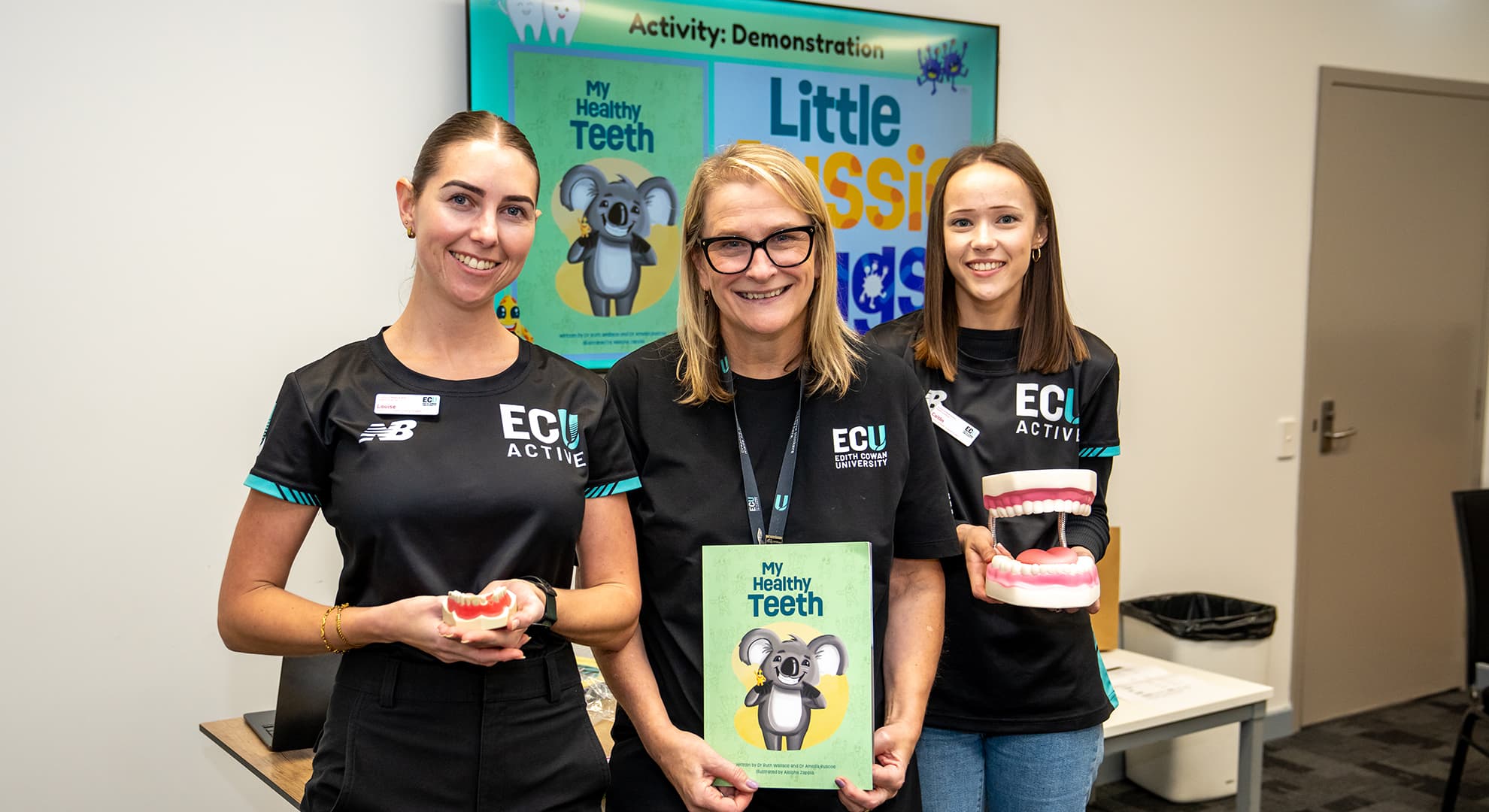
 Louise Miller, Dr Ruth Wallace and Caitlin Goddard at the Stirling workshop
Early childhood tooth decay affects nearly half of Australian preschool aged children, making it one of the most common chronic conditions in young children in the country.
Two Edith Cowan University (ECU) students wanting to turn those numbers around have taken their knowledge to the community, sharing important information on oral health for children with a group of migrant mothers.
Louise Miller and Caitlin Goddard - both in their final semester of a Bachelor of Health Science, majoring in Nutrition Bioscience at ECU – hosted a workshop at Stirling Leisure Centre, arranged through ISHAR Multicultural Women's Health Services.
"Early childhood caries (ECC) is the most common chronic condition in Australian preschool children, affecting eight per cent of children as early as 18 months old, with prevalence increasing significantly by the age of three years," Ms Miller explained. "Unfortunately, there is confusion among caregivers around fluoride use, brushing practices and dietary sugars, so we wanted to share this information and make it simple to understand.
"If we can instil good habits at an early age, hopefully they stay until adulthood."
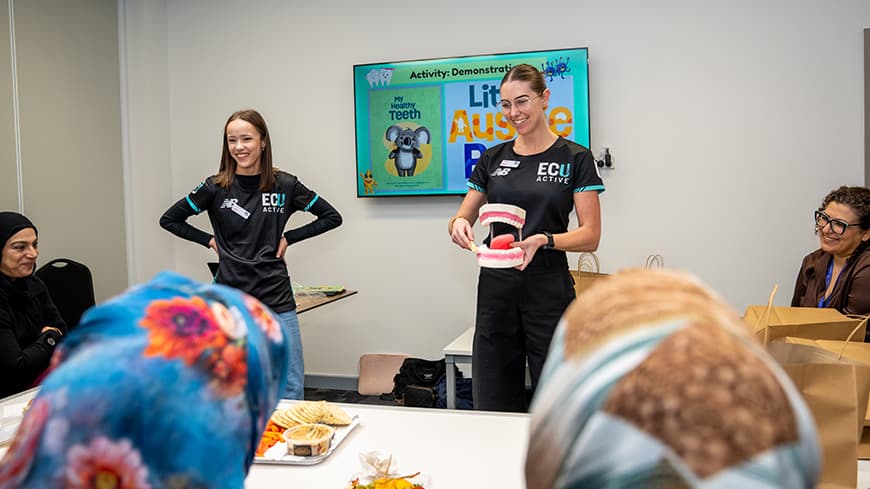 ECU students applying their knowledge in a real-world, preventative health setting.
The students and their supervisors Dr Ruth Wallace and Dr Lesley Andrew shared critical knowledge with the parents, gave out useful resources including a children's book on healthy teeth Little Aussie Bugs, toothbrushes and toothpaste, and answered questions in a relaxed, face-face setting.
"We took up this project as a practicum opportunity due to its strong alignment with our interests in community nutrition and health promotion," Ms Miller said. "It also allowed us to apply evidence-based research in a real-world, preventative health setting."
Senior lecturer with ECU's School of Medical and Health Sciences Dr Wallace, said research has indicated that many primary caregivers are not aware of the evidence-based oral health recommendations.
"Oral health workshops for parents of children aged under five years are essential because ECC is common, preventable, and driven by caregiver knowledge, feeding practices, and access to consistent advice," Dr Wallace said. "Involving nutrition students in the design and delivery of these workshops builds workforce capacity, while directly addressing inequities in health literacy through evidence based, community‑engaged practice."
Dr Wallace said in Western Australia, children living in rural and regional areas experience a 65 per cent higher rate of hospitalisation for emergency oral health treatment compared to metropolitan children.
"Evidence shows widespread confusion about diet, fluoride, oral hygiene, and dental attendance, underscoring the need for culturally responsive, prevention‑focused education," Dr Wallace said. "Migrant families face additional barriers related to language, cost, and service access."