 Image: Stephen Heath.
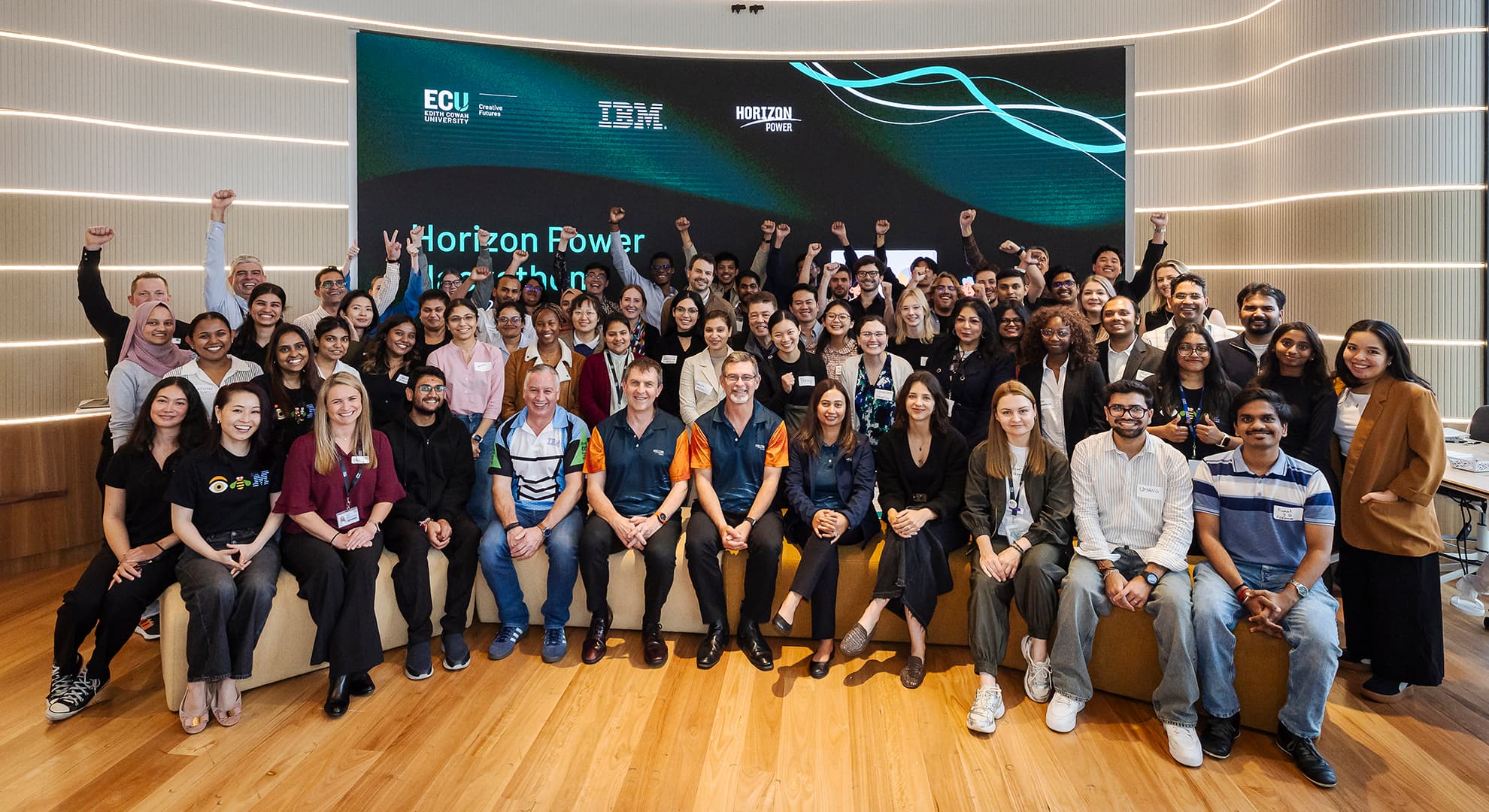
Collaboration was key for nearly 50 Edith Cowan University (ECU) students studying across five different Schools, who pooled their knowledge to tackle real-world challenges at the University's Horizon Power hackathon.
The initiative was developed through ECU's strategic partnership with IBM and co-delivered by ECU Creative Futures and the School of Business and Law.
IBM Future Lab interns provided mentorship and support to participants, while Western Australian energy provider Horizon Power contributed a real-world industry challenge for the one-day event, held at ECU City's new creative innovation studio, the CreatorsLAB.
Students began the day as strangers but formed strong bonds within their groups as they competed for the opportunity to interview for IBM's prestigious Future Lab internship program and present their winning concept to staff at Horizon Power.
It was this ability to foster strong collaboration and engagement amongst a multi-disciplinary cohort of students that impressed Horizon Power the most.
"Horizon Power is always looking for new ways to solve practical challenges, and the hackathon gave us access to fresh thinking from students across several disciplines," a Horizon Power spokesperson said.
"We were impressed by the quality of the ideas and the students' ability to turn complex problems into clear, practical concepts within a single day."
 Staff from Horizon Power and IBM provided their expertise to teams at the hackathon held at ECU City's CreatorsLAB. Image: Stephen Heath.
What is a hackathon?
A hackathon is a time-intensive event that requires teams to pose solutions to real-world industry challenges through innovative thinking and rapid prototyping.
At October's hackathon, Horizon Power presented groups with three real-world business challenges relating to IT asset management, cyber security awareness and equitable access to electric vehicle (EV) charging.
ECU Associate Dean (Business Systems and Operations) Associate Professor Flavio Romero Macau said the experience provided students with a unique opportunity to enhance their learning and teaching experience at ECU.
"From the student perspective, it's about learning how industry frames a challenge," Dr Macau said.
"It replicates situations they will face when they graduate and move into their jobs where they are assigned to ad hoc teams, they have big challenges proposed by their employers, and a timeline to come up with a solution."
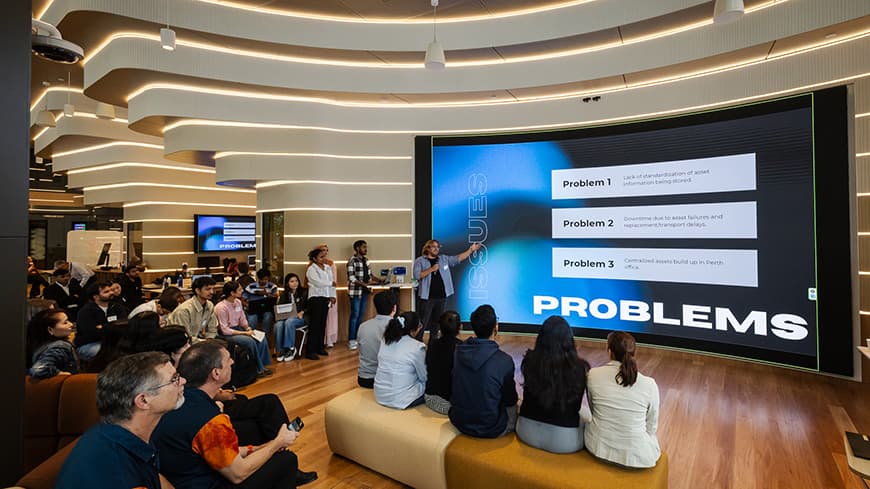 Students from multiple ECU schools pooled their knowledge to tackle real-world industry challenges. Image: Stephen Heath.
Through its strategic partnership with ECU, IBM helped bring Horizon Power into the initiative, connecting students with real-world industry challenges and expertise.
IBM Future Lab Director Andy Dawe said working with organisations such as Horizon Power gave students the opportunity to apply their learning to genuine industry challenges.
"The IBM Future Lab is about creating a bridge between what students learn at university and the challenges they will encounter in the workforce," Mr Dawe said.
"Horizon Power was a strong fit for this hackathon because it could bring genuine business challenges spanning technology, cybersecurity and the energy transition. Giving students the opportunity to work directly on those challenges helps them build practical skills."
Students excel under pressure to take out top prize
QueuedUp - a team consisting of students from the Schools of Arts and Humanities, Business and Law, and Science - took home the top prize for an innovative solution to Horizon Power's EV charging challenge.
The problem was clear: to manage the high demand placed on four EV chargers at Horizon Power's Bentley site, used by members of the public as well as approximately 80 Horizon Power employees.
The QueuedUp team made a prototype app to track both employee and public use of the charging stations as well as a digital queue to improve fairness while reducing both waiting time and cost.
QueuedUp team member and Bachelor of Design student Sophie Lawrence-Brown described her first-ever Hackathon as an experience that required every student to come out of their shells to succeed.
"It was really cool to collaborate with people not doing the same degree as me," Lawrence-Brown said.
"It was satisfying at the end where we presented our solution – and even better when we won. I wasn't expecting it. Presenting was like a proper, real-life interview. It was happening right then and there. It was really rewarding to take part in.
"I gained more confidence through the experience, working with new people I hadn't met before."
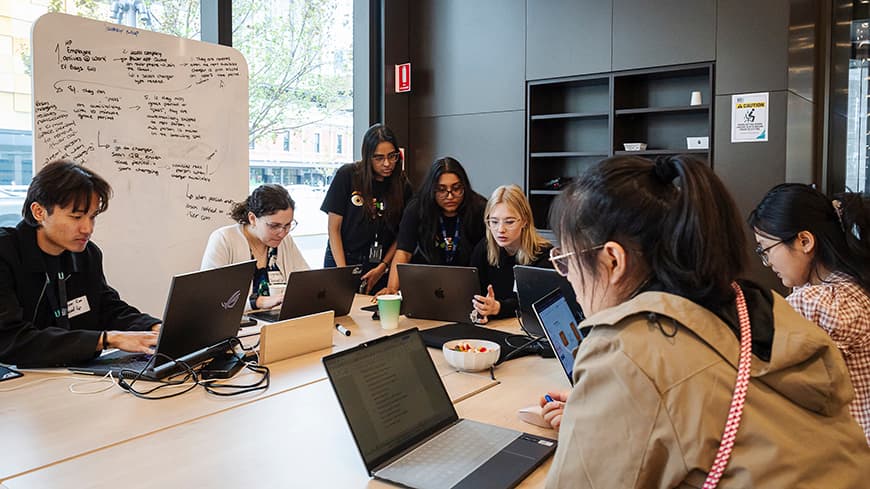 The QueuedUp team working with IBM Future Lab interns on their solution to the EV charging challenge. Image: Stephen Heath.
Hackathon a shining example of reciprocal collaboration
For Creative Futures, October's hackathon was an opportunity to immerse students in real-world challenges while strengthening connection between ECU and its industry partners.
Director of Creative Futures, Rebecca Gibson, said the hackathon illustrated the power of ECU's partnerships to encourage entrepreneurial thinking and collaboration in WA, while generating meaningful outcomes for partners through student-led solutions.
"We're creating impact in businesses, but also for our students by giving them real-world experiences and showcasing ECU as an action-oriented, diverse organisation that doesn't think in silos. That is what we're passionate about doing: unlocking the university for everybody," Gibson said.
"Just as the students brought different perspectives together to solve challenges, we worked closely with IBM to design and deliver the program. Having Horizon Power join that partnership and become part of the process created a genuine sense of shared purpose. by the end of the workshop day, it felt like a very close-knit group."
To find out more about what's on and Creative Futures partnerships, programs and events visit the Creative Futures webpage.