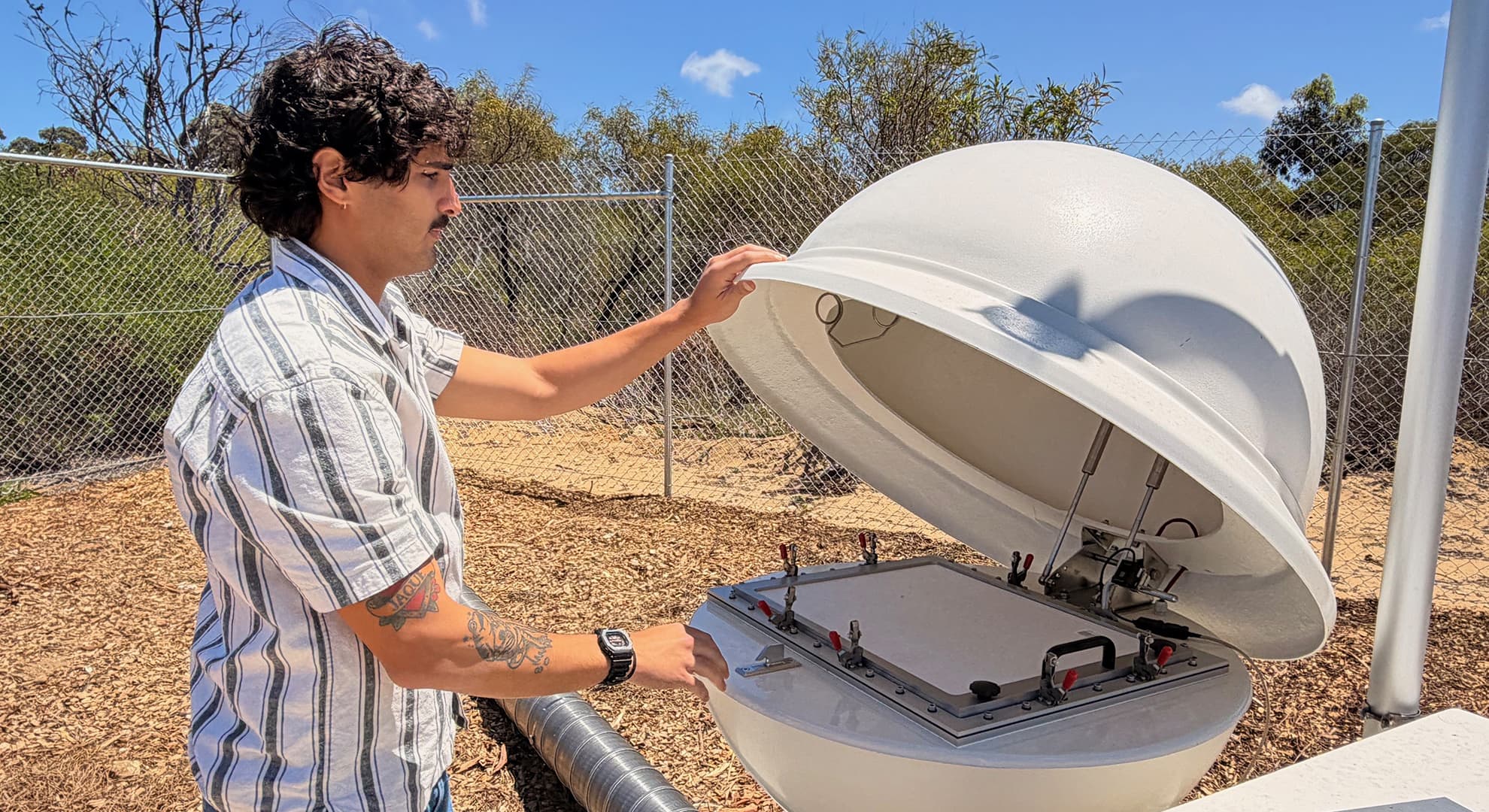
 The radionuclide station, based at the Joondalup campus, is the only site on mainland Western Australia, with the other located on Cocos (Keeling) Islands. Pictured: Antoniwal Augusto Jatobá Junior.
The radionuclide station, part of the Comprehensive Nuclear Test-Ban-Treaty Organization's (CTBTO) International Monitoring System (IMS) that looks for signs of such tests, was relocated to ECU's Joondalup campus from Perth Airport.
ECU has been working with scientists from the Australian Radiation Protection and Nuclear Safety Agency (ARPANSA), and CTBTO specialists over the past few months to ensure the new station meets the high standards set for the IMS.
CTBTO representatives from Vienna examined the station on 18 November before the site goes live in December.
Once fully operational, data from ECU will be transmitted to the CTBTO's International Data Centre (IDC) in Vienna for analysis and then distributed to all States Signatories.
Designed for year-round monitoring, the Perth station is equipped to measure radiation in the atmosphere. It works by filtering air to collect dust and other airborne particles over a 24-hour period. The filters are then analysed for radioactivity. If any radionuclides of interest are detected it may indicate a potential nuclear test explosion.
The station at ECU is the only site on mainland Western Australia, with the other being on Cocos (Keeling) Islands, and is one of 21 CTBTO facilities within Australia and its territories. ARPANSA manages eight of these facilities and supports the operations of stations abroad in Fiji, Antarctica and Kiribati.
ECU also hosts one of ARPANSA's ultraviolet radiation (UV) monitoring stations. ARPANSA operates a network of UV radiation detectors in major Australian cities and in the Australian Antarctic territories. The data from this site at ECU will give Western Australian's real-time information about when to use sun protection.
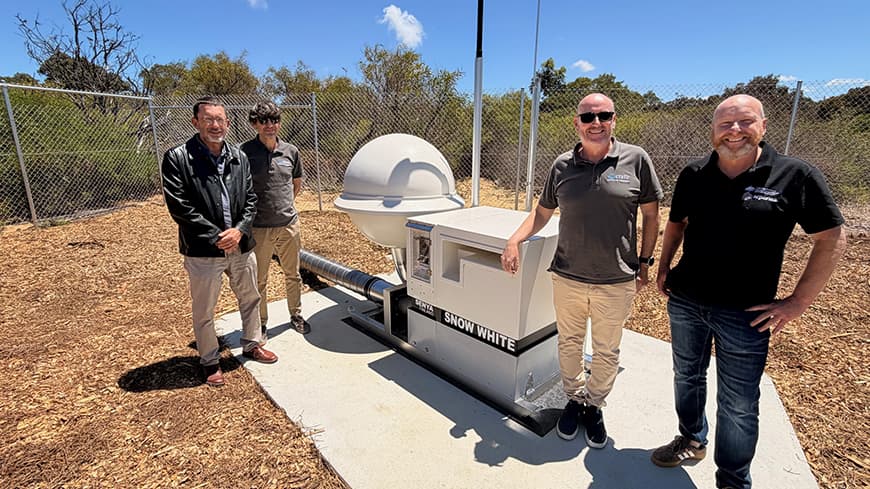 Representatives from the Comprehensive Nuclear Test-Ban-Treaty Organization (CTBTO) in Vienna, and Australian Radiation Protection and Nuclear Safety Agency (ARPANSA), are in Perth to inspect the station before it goes live. L-R Professor Pere Masque (ECU), Herbert Gohla and Ashley Davies (CTBTO) and David Hardman (ARPANSA).
Professor Stacey Reinke, Executive Dean – ECU School of Science said:
"Hosting Western Australia's only mainland radionuclide monitoring station represents a significant opportunity for ECU to contribute to an important global scientific and regulatory initiative.
"The new facility strengthens our partnerships with national and international agencies, optimises research capability and provides unique training opportunities for students and researchers, while supporting Australia's international commitments and environmental monitoring efforts."
Professor Pere Masque, ECU School of Science said:
"Strongly aligning with ECU’s expertise in environmental radioactivity, the implementation of this radionuclide station will create significant opportunities for both researchers and students.
"Operated by staff from the School of Science’s Environmental Radioactivity Laboratory, our role is to support reliable local operations in partnership with ARPANSA and the CTBTO, so that the measurements made here contribute to global verification efforts.
"The scientific value lies in identifying which radioactive isotopes are present and understanding what they tell us. Combined with measurements from other stations around the world, the observations allow identifying signals that point to further investigation.
"Natural radioactivity is always present in the environment, and distinguishing that background from other sources is a central part of our work."
ARPANSA's Monitoring Networks Director, David Hardman, said:
"We have been working with ECU scientists over the past few months to make sure they can operate and service this station locally.
"Radionuclide monitoring in WA is important to make sure Australia’s international obligations to the CTBT are met and helping to detect any nuclear explosions internationally.
"We work with local operators like ECU, and government colleagues such as the Australian Safeguards and Non-Proliferation Office to meet our treaty obligations through the installation, implementation, and operation of monitoring stations spread across the country as well as in Fiji, Kiribati and Antarctica.
"ECU will also be hosting our Perth UV monitoring station.
"ECU being the home for some of our radiation monitoring stations is a great example of how governments and universities work together to provide services that benefit the community."
CTBTO Executive Secretary, Robert Floyd, said:
"The International Monitoring System is only as strong as each of its stations and the people who look after them. Moving this station to ECU places it with scientists who know environmental radioactivity intimately and who will train the next generation in this work.
"In the 50 years before our Treaty opened for signature, the world saw more than 2,000 nuclear test explosions. In the 30 years since, there have been fewer than a dozen declared tests. That was a deliberate choice by the international community, and stations like this one help ensure that any departure from it would not go unnoticed.
"Having spent more than a decade leading Australia's safeguards and non-proliferation work, I am especially pleased to see an Australian university take on this role, working alongside ARPANSA in support of a safer world."
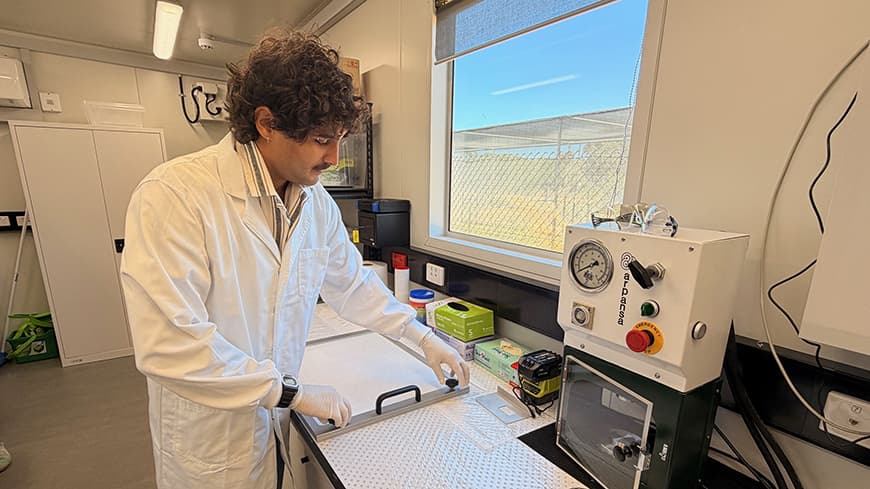 The filters collect dust and other airborne particles over a 24-hour period, and are then analysed for radioactivity. Pictured: Antoniwal Augusto Jatobá Junior.
Background
CTBT
The Comprehensive Nuclear-Test-Ban Treaty (CTBT), which bans all nuclear weapon test explosions, was opened for signature in New York on 24 September 1996. By ending nuclear testing, the Treaty constrains the development and qualitative improvement of nuclear weapons and the creation of advanced new types, making it an effective measure of both nuclear non-proliferation and disarmament. Australia signed the Treaty on the same day and ratified it on 9 July 1998.
Radionuclide monitoring is just one of four technologies used by the International Monitoring System (IMS), which, when complete, will have 321 facilities worldwide.
The IMS also includes seismic stations, which monitor shock waves through the ground; hydroacoustic stations, which pick up sound waves in the ocean; and infrasound stations, which detect ultra-low frequency sound waves inaudible to the human ear. If a nuclear test is carried out, those systems are likely to detect it first. Radiation levels measured as part of network operations are then used to corroborate that data.
UV
ARPANSA owns and maintains a network of UV detectors in cities around Australia and Antarctica. West Australians can easily access live UV Index measurements from ECU's station on ARPANSA’s website to check UV intensity in real time. These live measurements account for geographic location, altitude, time of day, time of year and cloud cover. The UV Index should be used every day, even on cool or overcast days, as UV radiation can still be high in these conditions. Clear skies or high temperatures cannot be relied on to determine when sun protection is needed.
Australia has some of the highest levels of UV radiation in the world, with UV radiation linked to up to 95% of melanomas.
If the UV index is 3 or more, ARPANSA recommends a combination of sun protection measures:
- slip on some sun-protective clothing that covers as much skin as possible
- slop on broad spectrum, water resistant SPF50 or SPF50+ sunscreen. Put it on 20 minutes before you go outdoors and every two hours afterwards
- slap on a hat – broad brim or legionnaire style to protect your face, head, neck and ears
- seek shade
- slide on some sunglasses – make sure they meet Australian Standards.