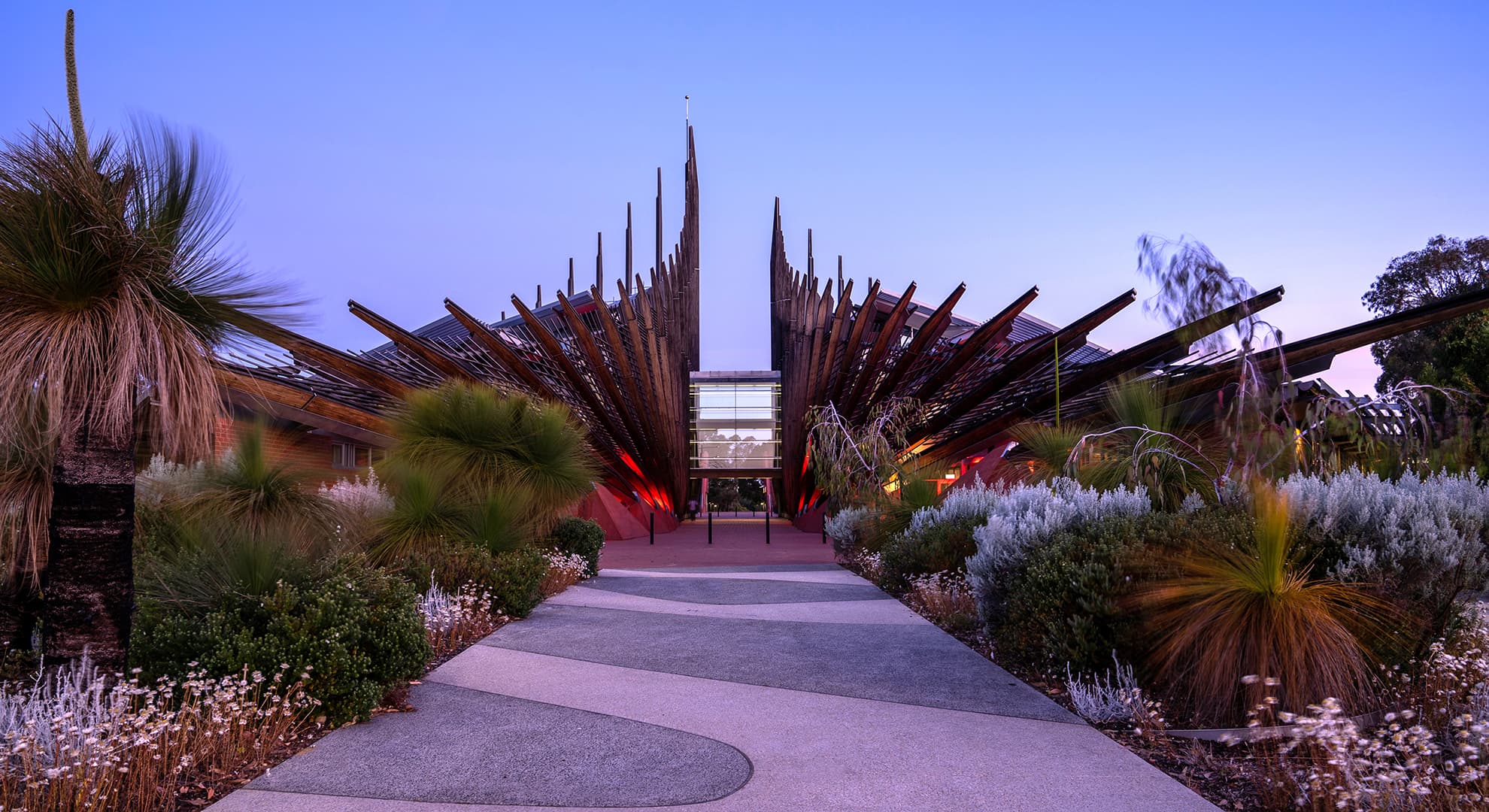
 The guidance of Elders has played a vital role in shaping ECU's cultural journey.
This year's NAIDOC Week theme, Fifty Years of Deadly, is both a milestone and a call forward.
It honours the Elders, advocates, educators and communities who built the foundations of today's movement, while recognising the next generation of Aboriginal and Torres Strait Islander leaders shaping Australia's future through culture, education, research, health, business and the arts.
At Edith Cowan University (ECU), that legacy is deeply woven into the University's history.
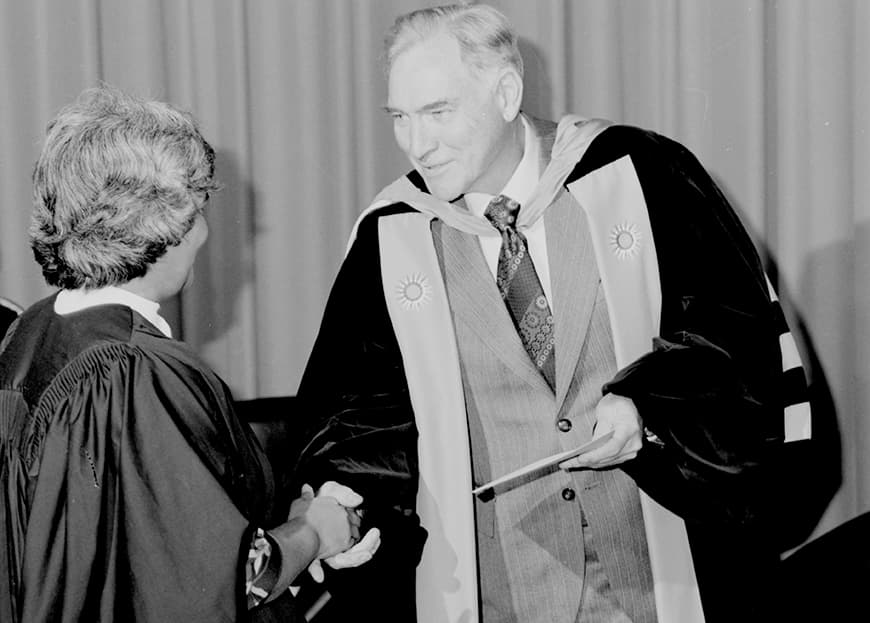 Aboriginal Teacher Education Program graduation ceremony, with chairperson Stanley Palmer.
From pioneering Indigenous teacher education programs to nationally significant Aboriginal research initiatives, ECU's journey reflects decades of commitment to recognising, celebrating and embedding Aboriginal and Torres Strait Islander knowledge, culture and leadership across the University community.
One of the earliest milestones dates back to 1951, when Len Hayward became the first Aboriginal graduate from Claremont Teachers College, one of ECU's predecessor institutions. Decades later, in 1976, the Aboriginal Teacher Education Program was established at Mount Lawley College of Advanced Education, becoming a groundbreaking initiative for Indigenous teacher training in Western Australia.
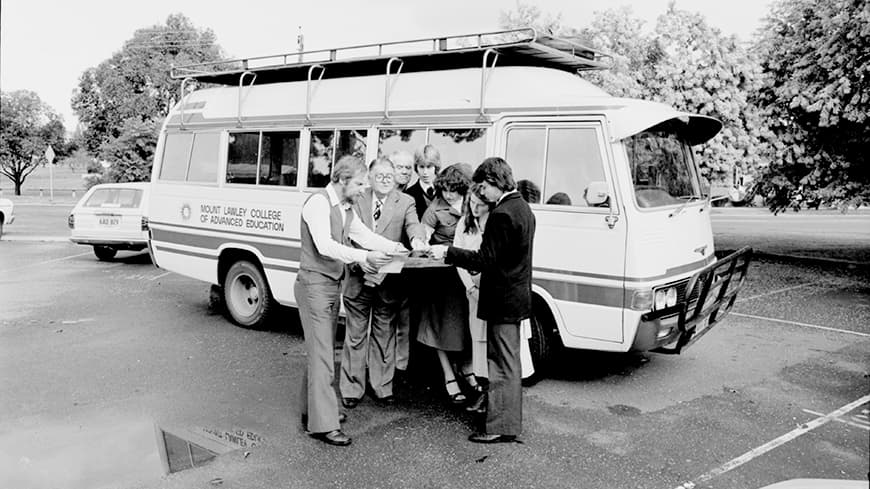 Staff and students from the former Mount Lawley College of Advanced Education
The establishment of Kurongkurl Katitjin in 1993 marked another defining chapter. Created as the School of Indigenous Australian Studies, it has grown into a nationally respected centre for Indigenous education, research and engagement, helping shape generations of Aboriginal and Torres Strait Islander scholars and leaders.
In 2000, ECU celebrated another landmark achievement when Dr Cheryl Kickett-Tucker became the University's first Aboriginal PhD graduate, a milestone that reflected the growing strength of Indigenous scholarship within the institution. Over the years, ECU has continued to build structures and initiatives that support reconciliation, cultural understanding and Indigenous leadership. These include the development of the ECU Indigenous Australian Employment Strategy and Action Plan in 2010, alongside the delivery of ECU's inaugural teaching unit in Indigenous Knowledge and Culture through the School of Education.
The following year, ECU hosted its first Reconciliation Roundtable, helping inform the development of the University's inaugural Reconciliation Action Plan.
Moments of reflection
Physical spaces across ECU campuses have also become powerful reflections of culture and connection to Country.
In 2014, the Welcome to Place cultural reflection space officially opened on the Joondalup campus, followed by Ngoolark, Boorna Baronga and Dambart Bilya cultural reflection spaces in subsequent years.
These spaces stand as visible reminders that culture belongs at the heart of learning and community.
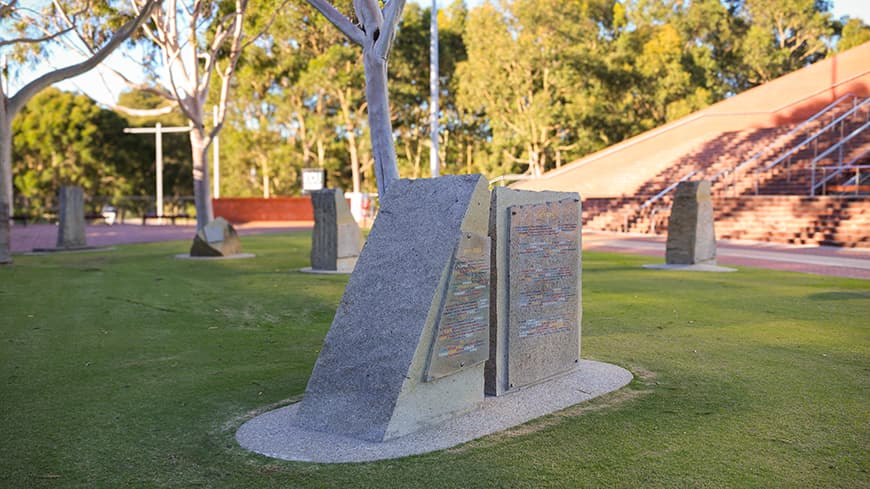 Cultural reflection spaces stand as visible reminders that culture belongs at the heart of ECU.
The guidance of Elders has also played a vital role in shaping ECU's cultural journey.
Dr Noel Nannup was appointed Kurongkurl Katitjin Elder-in-Residence in 2009, followed by the appointments of Lera Bennell and Aunty Oriel Green OAM as Elders-In-Residence for the Bunbury and Joondalup campuses in 2015. In 2019, Dr Roma Yibiyung Winmar was appointed as Elder-in-Residence at Kurongkurl Katitjin.
Their knowledge, leadership and cultural authority have helped strengthen ECU's relationships with community and Country.
Leadership at the University has continued evolving in recent years, with Professor Braden Hill appointed Deputy Vice-Chancellor (Students, Equity & Indigenous) in 2022 and Professor Dan McAullay appointed Dean of Kurongkurl Katitjin and Director of Aboriginal Research.
The same year also saw ECU continue embedding Aboriginal culture into the future Perth City Campus, including commissioning ECU alum and artist Jarni McGuire to create a Noongar cultural wordmark honouring Fanny Balbuk and Edith Cowan. In 2023, Clothilde Bullen OAM was appointed the inaugural Lead of Cultural Strategy and Development for the new campus.
Recent appointments have continued to break new ground.
In 2024, Professor Bep Uink became the first female and first Aboriginal Director of the Australian Indigenous HealthInfoNet within Kurongkurl Katitjin, while Dr Jocelyn Jones was appointed Vice-Chancellor's Associate Professorial Research Fellow at Kurongkurl Katitjin.
In April 2026, Professor McAullay as was appointed Pro Vice‑Chancellor(Indigenous), marking the first time the University has established the role as a standalone executive leadership position.
These milestones reflect more than institutional achievements. They represent generations of advocacy, cultural strength and community leadership, and a continuing commitment to ensuring Aboriginal and Torres Strait Islander voices are not only recognised, but centred.
The way forward
In 2025, ECU delivered its Cultural Narrative Framework, setting a significant foundation for future generations of students and staff at ECU, and contributing meaningfully to the broader education community.
This strategic framework is grounded in cultural narratives that help shape and inspire ECU. It reflects the essence of place, storytelling and connection, as understood through Aboriginal and Torres Strait Islander knowledge systems. These narratives are not positioned as isolated elements – they are powerful influences that can positively shape all areas of university life.
It also positions cultural diversity as a strength, promoting the infusing of a wide array of knowledge systems and cultures into ECU's teaching, research, student experience, corporate activities, community and public engagement.
Its aim is to embed this cultural foundation deeply into ECU's values, decision-making, environments and policies – ensuring that it actively contributes to how students, staff, and the broader community experience the University.
 The life layers at ECU City. Courtesy of Peter Bennetts, 2026
One of the foundational cultural narratives at the heart of the Cultural Narrative Framework, is 'Life Layers', which offers an alternative way of thinking, anchored in place, identity and relationship, which can inform everyday decisions and long-term planning.
The narrative was initially articulated by Dr Richard Walley OAM in consultation with Whadjuk Noongar Elders, and reflects the enduring connection between land, water and culture. It has guided and shaped the architectural and cultural design of ECU's new City Campus.
The 'Life Layers' narrative has been firmly embedded in the ECU City Campus, integrated into its façade, with artworks, signage and internal spaces reflecting their meaning.
With the opening of the transformative City Campus this year, the University's story continues to evolve alongside the broader story of NAIDOC Week itself: grounded in truth-telling, driven by culture and focused firmly on the future.
Because Fifty Years of Deadly is not simply about looking back.
It is about recognising the momentum still building, through education, research, community and culture, and ensuring the next generation grows up proud, connected and empowered to lead.