 Students and international experts work side by side to build the cleanroom's first satellite
"I can't believe when this satellite launches into space next year, my signature will be on there."
For ECU engineering student Andrew Burton, university wasn't supposed to include building a satellite destined for space.
Yet alongside fellow student Yash Fatania, Andrew has spent the past year helping assemble a spacecraft that will launch aboard a SpaceX Falcon 9 rocket in 2027.
The project, delivered through a partnership between Edith Cowan University (ECU) and Australian Earth observation company LatConnect 60 (LC60), is giving students direct, hands-on access to space engineering at a level rarely seen in universities anywhere in the world.
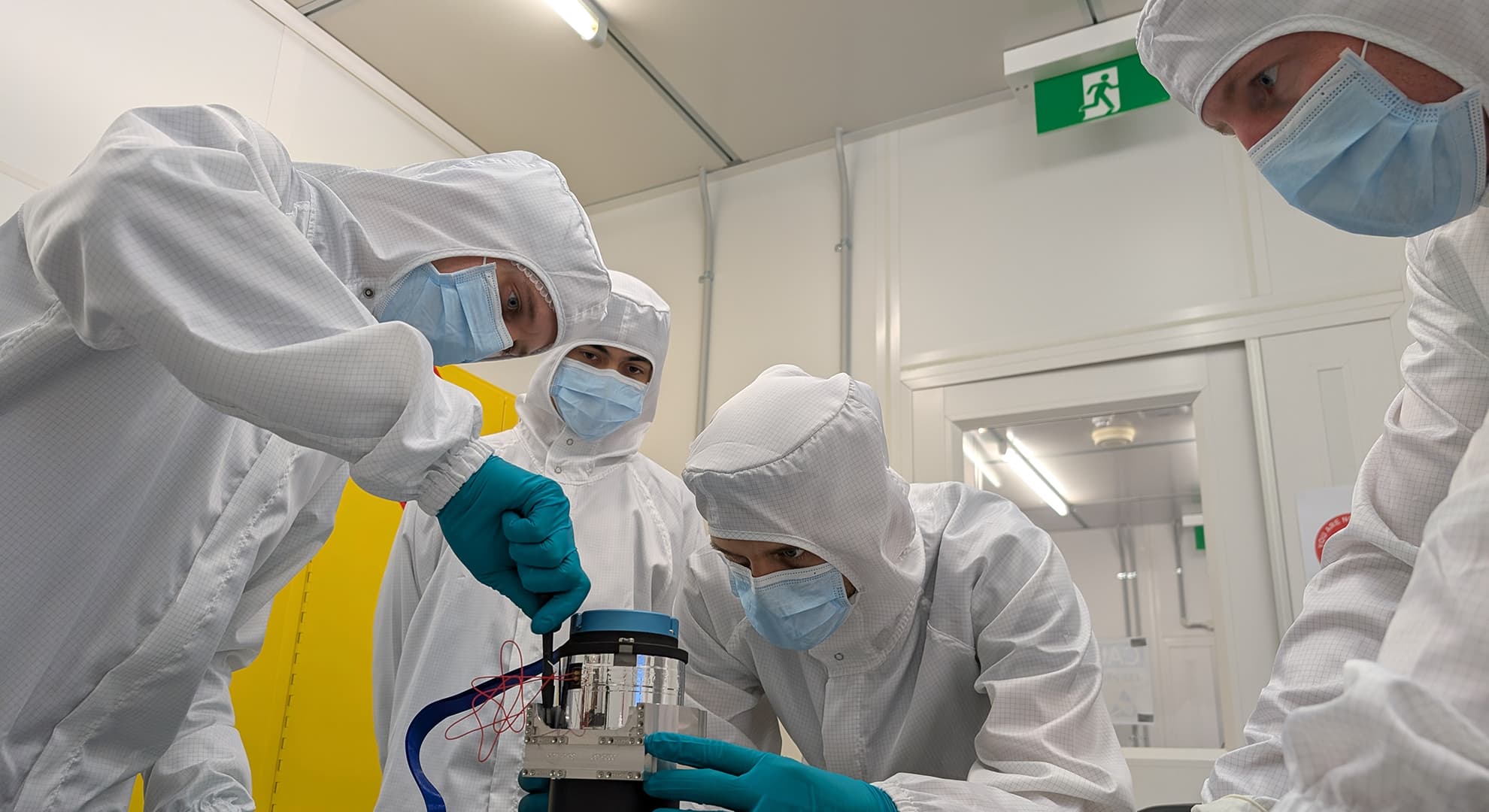
Inside the newly opened ISO 6 (Class 1000) cleanroom at the ECU Joondalup campus, one of the most advanced in the state, Andrew and Yash worked shoulder-to-shoulder with international experts from LC60 and engineers from Lithuanian small satellite integrator NanoAvionics.
"Two engineers flew out from Lithuania, and we were working alongside them right here on campus. It's the first time that's ever happened here," Yash said.
"We assembled the payload and integrated it - it was a very intense nine days."
Working side-by-side: experts and students in the ECU cleanroom
For Andrew, the experience has gone far beyond technical learning. It has been about contributing meaningfully to a live, high-stakes project.
"I felt valued because some of the ideas I proposed to the satellite engineers were actually implemented. For me, that was the highlight. It really made me feel like an integral member of the team."
Yash found the experience of working with technology destined for space uniquely satisfying.
"From cleanroom prep to hands-on integration, every part of this project pushed me," he said.
"Being able to bring ideas to the table, work through problems with engineers who do this for a living, and actually see those solutions implemented, that's incredibly rewarding. It's an experience I'll carry with me for a long time"
That satisfaction will reach a peak when the satellite launches in February 2027.
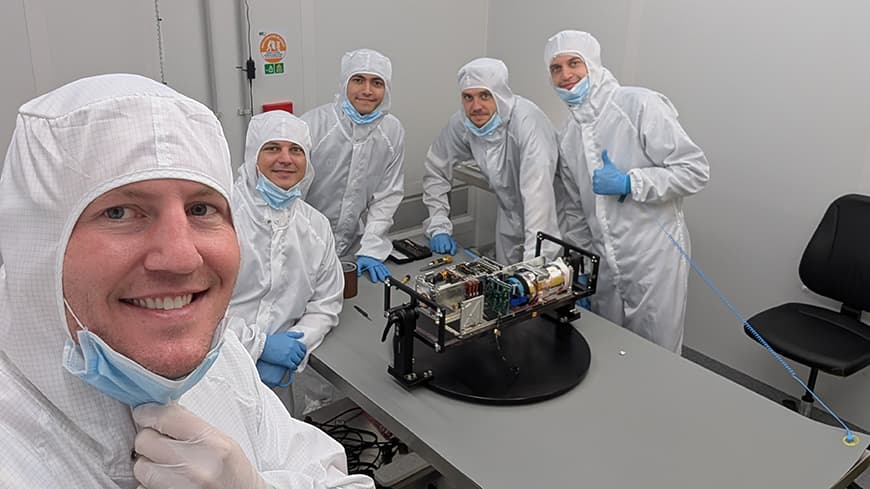 The team who built the cleanroom's first satellite (L to R): Ashley Smith (LatConnect 60), Andrew Burton (ECU), Yash Fatania (ECU), Pranas Ramanauskas (NanoAvionics) and Martynas Mikalauskas (NanoAvionics)
The satellite is part of LC60's SWIRSAT1 mission, designed to capture high-resolution data on carbon emissions and environmental changes.
It represents more than a single launch. It's the beginning of a constellation of Australian-built satellites and a major step toward establishing Western Australia as a global player in the space industry.
Students like Andrew and Yash are not just observing this transformation - they are at its centre.
For both students, the experience began with working on the cleanroom's compliance.
"Before we could even think about touching the satellite, we spent months getting this facility to the world standard required. Working to ECSS compliance from scratch was a project in itself," Yash explained.
"It has to be Class 1000, so for every cubic foot of air, there can be no more than 1,000 particulates."
It's meticulous, high-pressure work- but it's also the foundation for building space-grade technology.
The ECU experience doesn't stop in Perth.
In the second semester, Andrew and Yash will travel to Lithuania for six weeks, where they'll witness and contribute to critical testing phases at NanoAvionics.
This includes vibration testing, thermal vacuum chamber trials, and optical verification - essential steps before a spacecraft is cleared for launch.
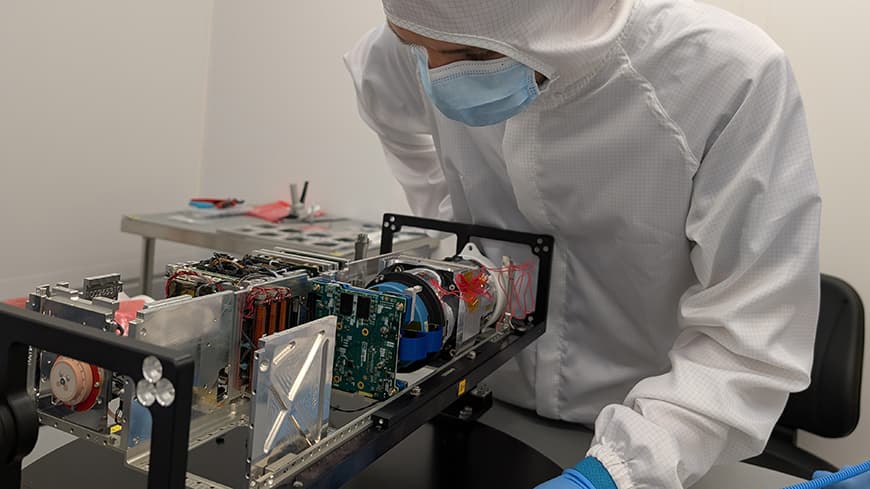 The satellite will be launched in February 2027
The project highlights the scale of what's being achieved at ECU.
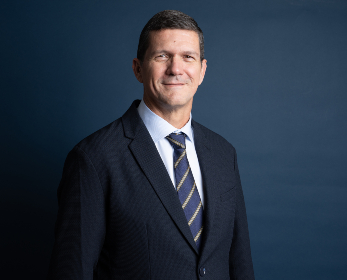
"Few universities globally can claim to be building satellites in partnership with industry at this level, let alone giving students a front-row seat," Deputy Vice-Chancellor Research, Professor Paulo de Souza said.
Supported by $3.5 million in State Government funding, the cleanroom facility marks a major milestone in Western Australia's space ambitions.
"It enables local assembly, integration and testing of satellites, all capabilities that are key to moving WA up the global space value chain."
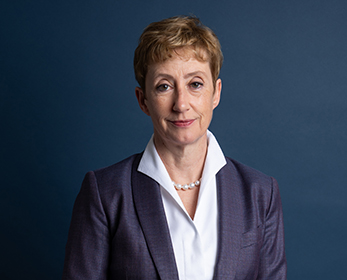
ECU Vice-Chancellor Professor Clare Pollock said the partnership ensures students gain real-world experience that directly feeds into industry capability.
"This facility connects our students directly to live space missions."
"To have our students helping build a satellite that will soon launch into space is extraordinary, but what excites me most is what they're learning through that experience and the opportunities it creates for their future careers," Professor Pollock said.
"This is exactly the kind of industry-connected learning that prepares ECU graduates to make a difference in the world."
Students who once studied satellites in textbooks are now building them with their own hands, contributing to missions that will support environmental monitoring, agriculture, national security and emergency response.
And when the Falcon 9 lifts off carrying their work into space, it will also carry something deeply personal.
"It'll be orbiting the Earth, and I'll know I had a hand in that," Andrew said.