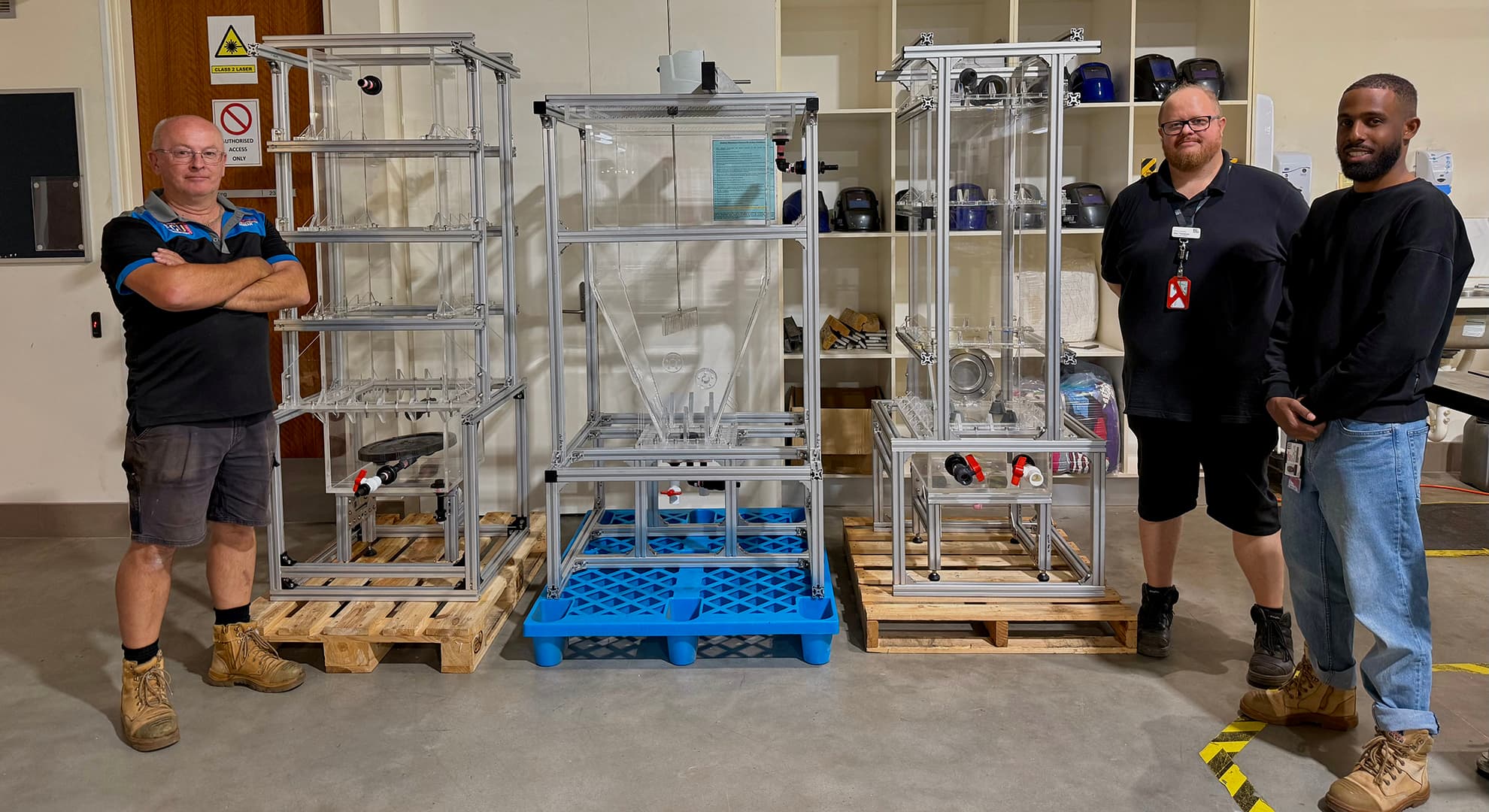
 L-R Adrian Davis, Technical Officer at School of Engineering; Glen Thompson, Senior Systems Engineer at School of Science and ECU PhD candidate Muigni El Kabir
Edith Cowan University (ECU) is working on ways to address excess ammonia in waterways, responding to growing challenges in water management.
A research project led by PhD candidate Muigi El Kabir, with input from ECU's School of Science, School of Engineering, and the Commonwealth Scientific and Industrial Research Organisation (CSIRO) has progressed beyond the laboratory with the successful delivery of a working system to recover ammonia from wastewater for environmental and economic reuse.
A strong partnership
ECU's collaboration with Water Corporation plays a central role in translating this research into practical, scalable outcomes. This relationship allows researchers to validate system performance under conditions that closely reflect those found in active wastewater treatment infrastructure.
The partnership is designed to accelerate innovation in water management by aligning academic research with industry priorities. This ensures that solutions such as ammonia recovery are developed with direct applicability to Western Australia's water systems.
Collaboration with ECU enables Water Corporation to engage early with emerging technologies, helping to de-risk adoption and identify opportunities for implementation at scale. At the same time, ECU researchers benefit from exposure to real operational challenges, allowing them to refine their designs in response to industry needs and regulatory considerations.
This partnership reflects a broader model of co-development, where research is not conducted in isolation but embedded within the ecosystems it aims to improve. By working alongside CSIRO and Water Corporation, ECU is helping to ensure that innovations in this research area move efficiently from concept to application, supporting more sustainable water management practices across the region.
Water Reactor Clarifiers
At the core of the project is a set of custom-built Water Reactor Clarifiers, designed to support Muigni's research apparatus. The system pre-treats wastewater, adjusts pH through aeration, and filters impurities, allowing ammonia recovery processes to be tested in real conditions.
The PhD is supervised through a three-way collaboration between Dr Sebastien Allard and Dr Anna Kaksonen (CSIRO), Professor Elizabeth Watkin (School of Science), and Associate Professor Amir Razmjou Chaharmahali (School of Engineering).
On the technical side, the project was led by Glen Thompson, Senior Systems Engineer in the School of Science, and Adrian Davis, Technical Officer in the School of Engineering. Working across both schools, the team shared workshops, equipment and expertise throughout the design and build process.
From concept to completion
The project required more than 100 hours of in-house computer aided design (CAD), with a strong focus on producing clear drawings for an external fabricator. This was critical given the one-off nature of the system and limited local manufacturing options.
Despite these constraints, the team delivered fully operational clarifiers within four months of commencing planning and design.
Post-fabrication testing confirmed that reinforcement modifications were required. These were completed in-house, allowing the project to stay on track and move quickly into operation.
The system now enables researchers to demonstrate the apparatus in action, supporting further study and potential industry partnerships.
Looking ahead
Beyond the immediate outcome, the project has strengthened collaboration across ECU's technical teams and highlighted new approaches to prototyping and fabrication.
It has also led to the formation of a Technical Staff Community of Practice, aimed at improving access to expertise and equipment across schools.
With the system now operational, the next phase of research will focus on advancing ammonia recovery processes and exploring future applications.