 148 students from 26 schools are taking part in the IGNIS Internship Program
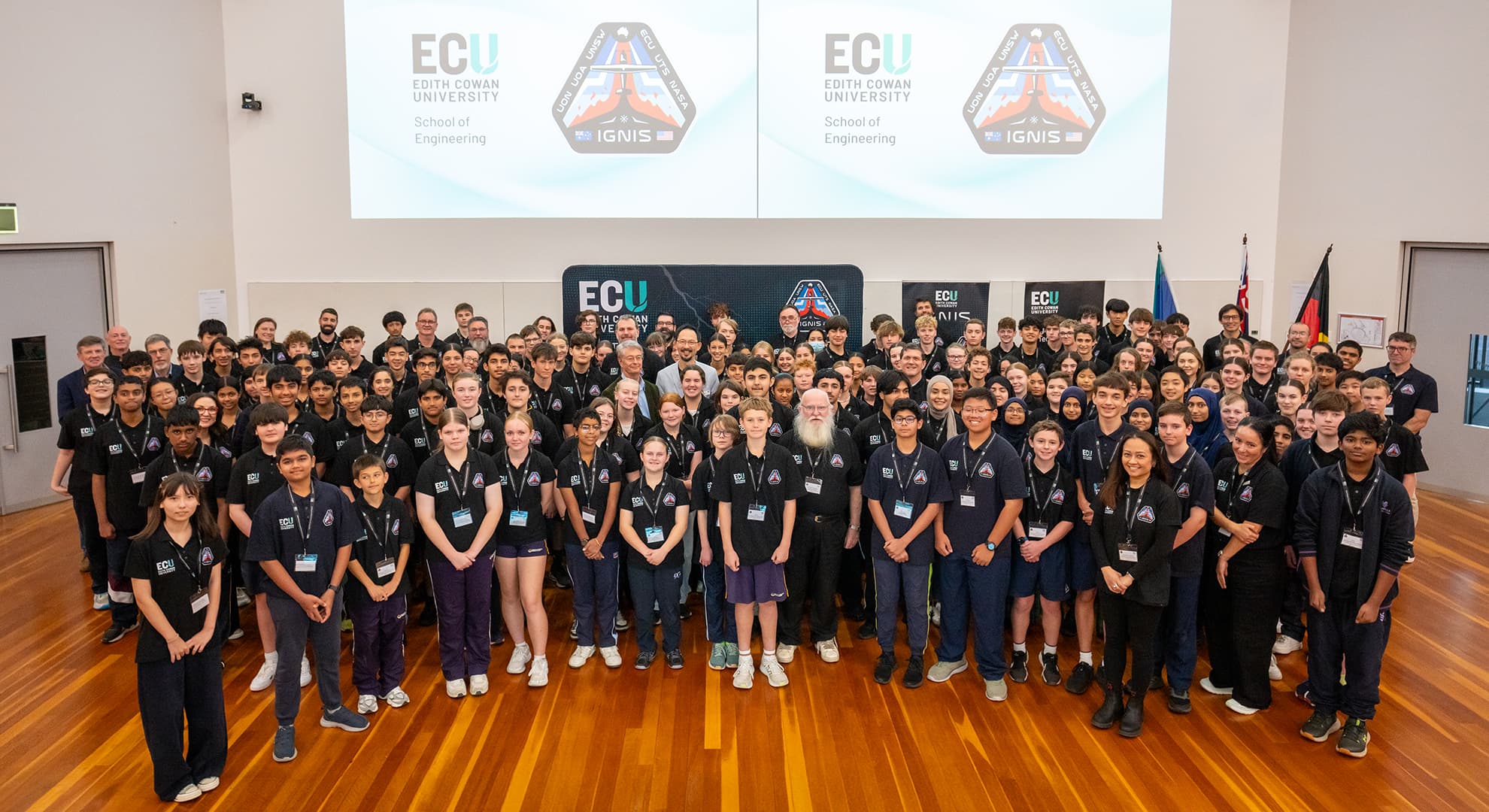
A total of 148 students from 26 schools have embarked on the immersive STEM program, which officially begins on 1 July (Term 2, Week 10).
Designed for Years 7 to 11, the IGNIS internship offers a rare opportunity for students to contribute to real-world research in partnership with NASA, predicting lightning-caused bushfires using advanced space technology.
"It's incredibly exciting to be giving students the chance to get involved in hands-on STEM research that's happening right here in Western Australia," said ECU IGNIS Workshop Coordinator from the School of Engineering, Daizee Wiles.
The program was officially launched at ECU, where students participated in a full day of on-campus activities, including workshops in resilience and media training.
The Noongar Boodja Ranger Team also played a significant role, sharing cultural knowledge and insights that underpin the IGNIS project.
"What's most important to us is that the students left excited and inspired," Ms Wiles said.
We had students coming up to us afterwards and teachers emailing to say how much they enjoyed it. That excitement is what this program is all about.
Lightning is responsible for hundreds of bushfires across Western Australia each year, many igniting in remote regions and burning undetected for days.
The IGNIS project aims to address this challenge through real-time lightning detection and 3D imaging technology, providing firefighters with earlier warnings and critical information to support response efforts.
Participating schools include Governor Stirling Senior High School, Aquinas College, Australian Islamic College, Balcatta Senior High School, Perth College Anglican School and Willeton Senior High School.
Across five on-campus sessions at ECU, students will experience university life firsthand, working alongside academics, aerospace professionals, NASA scientists, and Aboriginal rangers.
They will also build mini weather stations in their classrooms to collect environmental data such as temperature, soil moisture, and humidity which help predict conditions that lead to lightning-triggered bushfires.
"Programs like IGNIS are about more than engineering. They're about exposure," Ms Wiles said.
Students are learning directly from professionals in industry, building networks, and gaining insight into pathways they may never have considered.
The IGNIS mission is an international collaboration involving ECU, NASA, and leading Australian universities including the University of New South Wales, the University of Adelaide, the University of Technology Sydney, and the University of Newcastle. ECU is the only Western Australian university participating.
"IGNIS harnesses space technology to tackle one of Australia's most pressing challenges," said ECU Deputy Vice-Chancellor Research and IGNIS Mission Leader Professor Paulo de Souza.
"This pioneering work will give us vital insights into fire prediction and community safety. It has the potential to save thousands of lives around the world. By improving our ability to predict and respond to bushfires, the research could also help reduce the enormous economic costs associated with fire damage, disaster recovery and lost productivity."
Future stages of the project include the launch of a CubeSat satellite into low Earth orbit to monitor lightning and thermal patterns from space - technology the students themselves will help design.
The program will culminate in a graduation ceremony on 30 November, where students will be recognised for their contributions to the IGNIS mission with certificates and NASA-linked acknowledgements.
"IGNIS is about empowering students to see themselves as part of something bigger," Ms Wiles said.
"They're not just exploring STEM. They're shaping its future."