
 Australia’s Economic Accelerator (AEA) Ignite program provides grants to support early-stage research commercialisation.
Changing the frequency
Associate Professor Shihao Yan from the School of Science, has been awarded $471,400 to detect and disrupt rogue drones. The technology is based on a rapid drone detection and jamming system that targets the same radio frequencies drones rely on to fly.
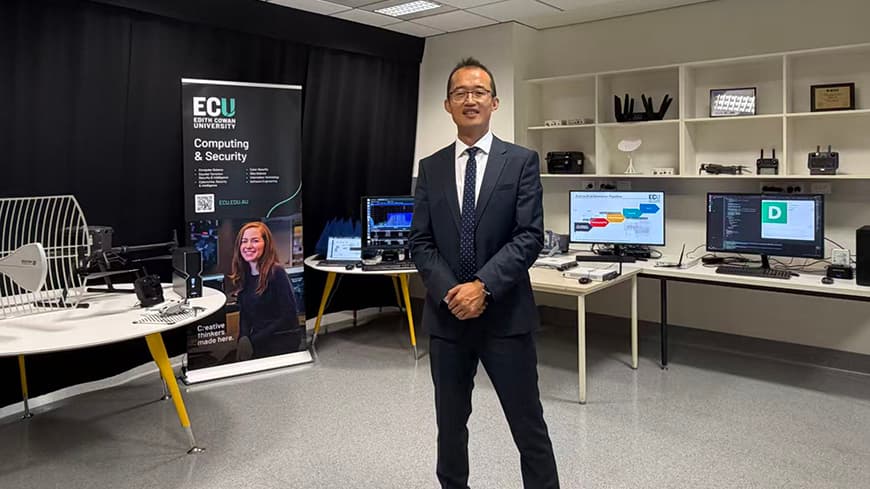 ECU Associate Professor Shihao Yan
The technology is able to identify a drone in under one second, pinpoint its operating frequency, and deliver a low-power, highly targeted radio interruption that breaks the link between the drone and its operator without disrupting nearby devices.
When operational, the technology will be mounted on a mobile, battery-powered unit for outdoor trials with a detection range of up to one kilometre.
Associate Professor Yan said the project addresses a growing and urgent security gap.
"Our goal is a fast, precise and safe way to deal with unwanted drones," he said. "By using focused, low-power signals instead of blunt jamming, we can protect sensitive sites while minimising interference and energy use."
Strides in rare mineral recovery
Under a separate AEA Ignite grant, in partnership with Everest Metals, Associate Professor Amir Razmjou and Lead Entrepreneur Dr Matt Myers have received $403,942 (which includes a $60,000 in-kind/cash direct contribution from Everest Metals) to advance a new Direct Rubidium Extraction (DRE) process.
Based at the Mineral Recovery Research Centre, the team will combine extraction and purification technologies to lift the project's Technology Readiness Level, positioning Australia for an onshore supply of the critical mineral rubidium.
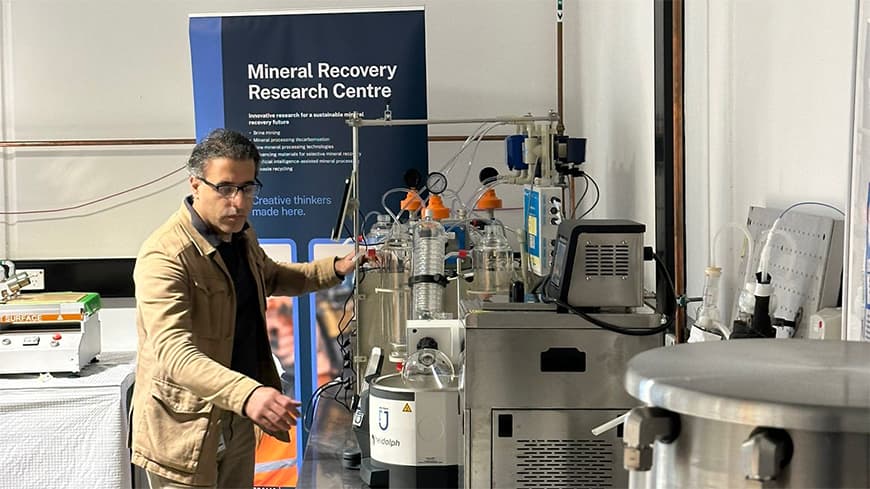 ECU Associate Professor Amir Razmjou
The work builds on an ongoing collaboration with Everest Metals' Mt Edon critical minerals project and is expected to help establish a new domestic rubidium industry.
Associate Professor Razmjou said the funding accelerates both technology development and industry impact.
"This project positions our team at the forefront of rubidium extraction in Australia and strengthens our partnership with industry. It's a major step towards an economic and sustainable onshore supply chain."
Dr Myers added the project would also support broader commercialisation goals.
"It gives us hands-on experience translating advanced mineral recovery technologies into real-world applications. That includes rubidium today and lithium and other critical minerals in the future."
Both projects align with National Reconstruction Fund priority areas and highlight ECU's growing role in translating research into practical, high-impact solutions for national security and critical minerals.