
Master of News and Entertainment Media
Course code Q00
Why study at ECU?
-

A great student experience
As an ECU postgraduate, you can expect the best overall student experience of any public universities in Western Australia. More about QILT.
-

A 5-star postgrad experience
Our postgraduate students have rated us 5 stars for their overall experience in the latest Good Universities Guide. More 5-star ratings included: skills development, student support and teaching quality.
-

One of the world's young guns
We're ranked one of the world's best universities under 50 years old, and we've already established a global reputation for such a young institution.
Toggle between study options for Domestic or International students
About this Course
If you aspire to working in the news and entertainment media or aligned industries, this course will prepare you for a range of roles in the media industry and beyond.
You’ll learn the basics of journalism to the practicalities of reporting and presenting news, entertainment and other content, across tv, radio, streaming, online, and various digital storytelling platforms.
And because we have specialist studio units that replicate working media newsrooms and production houses, you’ll make news and entertainment shows while working to industry deadlines, and a focus on live delivery.
The Masters also includes management skills, delivered through the lens of the media industry: the psychology of decision making, unconscious bias, data analytics, audience dynamics and understanding consumer behaviour.
Australian Qualifications Framework (AQF) level
This course has been accredited by ECU as an AQF Level 9 Masters Degree (Coursework) Award.
Course code
Q00Entry requirements
ECU admission and English language requirements apply.
See Course Entry for further information.
Admissions
Fees
Domestic fee paying - estimated 1st year indicative fee AUD $25,550
See Fees and Scholarships for further information.
Availability & Campus
| Location | Semester 1 | Semester 2 |
|---|---|---|
| City Campus | FT PT | FT PT |
| Joondalup | ||
| South West | ||
| Sri Lanka | ||
| Online |
About this Course
If you aspire to working in the news and entertainment media or aligned industries, this course will prepare you for a range of roles in the media industry and beyond.
You’ll learn the basics of journalism to the practicalities of reporting and presenting news, entertainment and other content, across tv, radio, streaming, online, and various digital storytelling platforms.
And because we have specialist studio units that replicate working media newsrooms and production houses, you’ll make news and entertainment shows while working to industry deadlines, and a focus on live delivery.
The Masters also includes management skills, delivered through the lens of the media industry: the psychology of decision making, unconscious bias, data analytics, audience dynamics and understanding consumer behaviour.
Australian Qualifications Framework (AQF) level
This course has been accredited by ECU as an AQF Level 9 Masters Degree (Coursework) Award.
Course code
Q00CRICOS code
117363AEntry requirements
ECU admission and English language requirements apply.
See Course Entry for further information.
Fees
International students - estimated 1st year indicative fee AUD $41,150
See Fees and Scholarships for further information.
Availability & Campus
| Location | Semester 1 | Semester 2 |
|---|---|---|
| City Campus | FT | FT |
| Joondalup | ||
| South West | ||
| Sri Lanka | ||
| Online |
Course Entry
Admission requirements you'll need to meet for this course.
-
The following course-specific admission requirements are mandatory and must be satisfied by all applicants. These requirements are in addition to or supersede the minimum requirements outlined within the Academic admission requirements band section below.
All applicants are required to meet the published entry requirements. This course allows eligible applicants to use their Bachelor, Graduate Certificate or Graduate Diploma studies as the basis for up to 60 credit points of Credit and Recognition of Prior Learning (CRPL), where they have completed a degree in a specified discipline (or with appropriate experience):
You may be able to receive CRPL if you have any of the following:
- A Bachelor degree, or major, in a related discipline*, or
- A Bachelor degree with relevant coursework, plus two years relevant work experience^, or
- A Graduate Certificate, or Graduate Diploma, of Broadcasting (or equivalent).
*Related discipline refers to any Broadcast Media or Journalism related discipline.
~Relevant course work includes Arts or Creative Industries with any major (other than those above).
^Relevant work experience constitutes Journalism positions to be approved by the Course Coordinator.
All applications are assessed individually, and the exact amount of credit awarded will depend on how your previous study or experience aligns with this course.Academic admission requirements (Band 6) may be satisfied through completion of one of the following:
- Bachelor degree; or
- Equivalent prior learning including at least five years relevant professional experience.
-
English competency requirements may be satisfied through completion of one of the following:
- IELTS Academic Overall band minimum score of 6.5 (no individual band less than 6.0);
- Bachelor degree from a country specified on the English Proficiency Bands page;
- Successfully completed 0.375 EFTSL of study at postgraduate level or higher at an Australian higher education provider (or equivalent);
- Where accepted, equivalent prior learning, including at least five years relevant professional experience; or
- Other tests, courses or programs defined on the English Proficiency Bands page.
Course Entry
Admission requirements you'll need to meet for this course.
-
The following course-specific admission requirements are mandatory and must be satisfied by all applicants. These requirements are in addition to or supersede the minimum requirements outlined within the Academic admission requirements band section below.
All applicants are required to meet the published entry requirements. This course allows eligible applicants to use their Bachelor, Graduate Certificate or Graduate Diploma studies as the basis for up to 60 credit points of Credit and Recognition of Prior Learning (CRPL), where they have completed a degree in a specified discipline (or with appropriate experience):
You may be able to receive CRPL if you have any of the following:
- A Bachelor degree, or major, in a related discipline*, or
- A Bachelor degree with relevant coursework, plus two years relevant work experience^, or
- A Graduate Certificate, or Graduate Diploma, of Broadcasting (or equivalent).
*Related discipline refers to any Broadcast Media or Journalism related discipline.
~Relevant course work includes Arts or Creative Industries with any major (other than those above).
^Relevant work experience constitutes Journalism positions to be approved by the Course Coordinator.
All applications are assessed individually, and the exact amount of credit awarded will depend on how your previous study or experience aligns with this course.Academic admission requirements (Band 6) may be satisfied through completion of one of the following:
- Bachelor degree; or
- Equivalent prior learning including at least five years relevant professional experience.
-
English competency requirements may be satisfied through completion of one of the following:
- IELTS Academic Overall band minimum score of 6.5 (no individual band less than 6.0);
- Bachelor degree from a country specified on the English Proficiency Bands page;
- Successfully completed 0.375 EFTSL of study at postgraduate level or higher at an Australian higher education provider (or equivalent);
- Where accepted, equivalent prior learning, including at least five years relevant professional experience; or
- Other tests, courses or programs defined on the English Proficiency Bands page.
Course Details
Semester availability
Semester 1: Study full-time , City Campus
Semester 1: Study part-time , City Campus
Semester 2: Study full-time , City Campus
Semester 2: Study part-time at City Campus
Course Structure
Students are required to complete 6 core units (totalling 160 credit points) and 4 core option units (totalling 80 credit points).
| Unit Code | Unit Title | Credit Points |
|---|---|---|
| NEM6100 | News and Entertainment Journalism | 20 |
| NEM6105 | Radio Presentation and Production | 20 |
| Plus, select one core option unit from the following (20 credit points): | ||
| MSP6100 ^ | Screen Storytelling | 20 |
| MSP6140 ^ | Screen Production Skills | 20 |
| CMM6510 ^ | Social and Digital Media Communication | 20 |
| FBL5020 ^ | Marketing Leadership | 20 |
| FBL5010 ^ | Managing People and Organisations | 20 |
| Unit Code | Unit Title | Credit Points |
|---|---|---|
| NEM6110 | Multiplatform News and Entertainment | 20 |
| NEM6115 | TV Presentation and Production | 20 |
| Plus, select one core option unit from the following (20 credit points): | ||
| CMM6530 ^ | Creative Communication | 20 |
| FBL5020 ^ | Marketing Leadership | 20 |
| FBL5010 ^ | Managing People and Organisations | 20 |
| Unit Code | Unit Title | Credit Points |
|---|---|---|
| NEM6150 | Media Production Studio 1 | 40 |
| Plus, select one core option unit from the following (20 credit points): | ||
| MSP6120 ^ | Screen and Media Research and Innovation | 20 |
| MSP6125 ^ | Screen and Media Industry Placement | 20 |
| Unit Code | Unit Title | Credit Points |
|---|---|---|
| NEM6160 | Media Production Studio 2 | 40 |
| Plus, select one core option unit from the following (20 credit points): | ||
| NEM6125 ^ | Media Strategy and Leadership | 20 |
| MSP6125 ^ | Screen and Media Industry Placement | 20 |
^ Core Option
Q00|3
For more detailed unit information for this course take a look at our Handbook. To organise your life for next semester visit the Teaching timetable.
Student handbookCourse notes
Important course notes
-
NEM6130 Media Production Internship
Attendance requirements
Completion of 175 hours of placement in an approved professional work environment.
Course learning outcomes
- Reflect critically on a complex body of news and entertainment media industry knowledge, research principles and methods to demonstrate mastery of news and entertainment storytelling and production.
- Apply cognitive, technical and creative skills to investigate, evaluate and synthesise complex ideas to make high quality news and entertainment media packages and culturally responsive editorial decisions for a variety of audiences.
- Apply communication, collaboration and digital literacy skills to contribute to ethical, professional-level news and entertainment media packages, decisions and scholarship.
- Use high level self management and independent learning skills to initiate, plan, and execute substantial news and entertainment media projects.
Course Details
Semester availability
Semester 1: Study full-time at City Campus
Semester 2: Study full-time at City Campus
Course Structure
Students are required to complete 6 core units (totalling 160 credit points) and 4 core option units (totalling 80 credit points).
| Unit Code | Unit Title | Credit Points |
|---|---|---|
| NEM6100 | News and Entertainment Journalism | 20 |
| NEM6105 | Radio Presentation and Production | 20 |
| Plus, select one core option unit from the following (20 credit points): | ||
| MSP6100 ^ | Screen Storytelling | 20 |
| MSP6140 ^ | Screen Production Skills | 20 |
| CMM6510 ^ | Social and Digital Media Communication | 20 |
| FBL5020 ^ | Marketing Leadership | 20 |
| FBL5010 ^ | Managing People and Organisations | 20 |
| Unit Code | Unit Title | Credit Points |
|---|---|---|
| NEM6110 | Multiplatform News and Entertainment | 20 |
| NEM6115 | TV Presentation and Production | 20 |
| Plus, select one core option unit from the following (20 credit points): | ||
| CMM6530 ^ | Creative Communication | 20 |
| FBL5020 ^ | Marketing Leadership | 20 |
| FBL5010 ^ | Managing People and Organisations | 20 |
| Unit Code | Unit Title | Credit Points |
|---|---|---|
| NEM6150 | Media Production Studio 1 | 40 |
| Plus, select one core option unit from the following (20 credit points): | ||
| MSP6120 ^ | Screen and Media Research and Innovation | 20 |
| MSP6125 ^ | Screen and Media Industry Placement | 20 |
| Unit Code | Unit Title | Credit Points |
|---|---|---|
| NEM6160 | Media Production Studio 2 | 40 |
| Plus, select one core option unit from the following (20 credit points): | ||
| NEM6125 ^ | Media Strategy and Leadership | 20 |
| MSP6125 ^ | Screen and Media Industry Placement | 20 |
^ Core Option
Q00|3
For more detailed unit information for this course take a look at our Handbook. To organise your life for next semester visit the Teaching timetable.
Student handbookCourse notes
Important course notes
-
NEM6130 Media Production Internship
Attendance requirements
Completion of 175 hours of placement in an approved professional work environment.
Course learning outcomes
- Reflect critically on a complex body of news and entertainment media industry knowledge, research principles and methods to demonstrate mastery of news and entertainment storytelling and production.
- Apply cognitive, technical and creative skills to investigate, evaluate and synthesise complex ideas to make high quality news and entertainment media packages and culturally responsive editorial decisions for a variety of audiences.
- Apply communication, collaboration and digital literacy skills to contribute to ethical, professional-level news and entertainment media packages, decisions and scholarship.
- Use high level self management and independent learning skills to initiate, plan, and execute substantial news and entertainment media projects.
Fees and Scholarships
Fees
- AUD $25,550 - Domestic fee paying estimated 1st year indicative fee 1
Note
1 The 'estimated 1st year indicative fee' is provided as a guide only, based on a typical enrolment of students undertaking the first year of this course. At ECU, you pay for the individual units you enrol in, not an overall course fee, so the total cost of your course will vary, depending on what units you choose. An indicative fee will be provided with your course offer, however you can use our Course Fee Calculator to estimate the actual amount you'll need to pay. ECU fees are adjusted annually.
Some units require the payment of a fee for incidental goods or services required to complete those units. For more information and the full list of incidental fees for courses and units, visit What are Incidental Fees.
Scholarships
ECU has a scholarship program that provides many opportunities each year to students undertaking studies here.
Find a scholarshipCareer Opportunities
This course can lead you to a huge variety of media roles. These include reporter/journalist, editor, photojournalist, investigative journalist, columnist, tv and radio news presenter, producer, director, social media manager, Youtuber, content creator, blogger/vlogger, podcaster, podcast producer, screen writer, video editor, sound engineer, copywriter, communications manager, media relations specialist, press secretary, voice over artist or storyteller.
Similar courses to consider
Fees and Scholarships
Fees
- AUD $41,150 - International students estimated 1st year indicative fee 1
Note
1 The 'estimated 1st year indicative fee' is provided as a guide only, and has been calculated based on a typical enrolment of students undertaking the first year of this course. At ECU, you pay for each individual unit you enrol in, not an overall course fee, so the total cost of your course will vary, depending on what units you choose. An indicative fee will be provided with your course offer, however you can use our Course Fee Calculator to estimate the actual amount you'll need to pay. ECU fees are adjusted annually.
Some units require the payment of a fee for incidental goods or services required to complete those units. For more information and the full list of incidental fees for courses and units, visit What are Incidental Fees.
Scholarships
ECU has a scholarship program that provides many opportunities each year to students undertaking studies here.
Find a scholarshipCareer Opportunities
This course can lead you to a huge variety of media roles. These include reporter/journalist, editor, photojournalist, investigative journalist, columnist, tv and radio news presenter, producer, director, social media manager, Youtuber, content creator, blogger/vlogger, podcaster, podcast producer, screen writer, video editor, sound engineer, copywriter, communications manager, media relations specialist, press secretary, voice over artist or storyteller.
Similar courses to consider
Need some help deciding what to study?
Our future student events include a mix of on-campus and online sessions designed to help you decide what to study at ECU.
Discover what it's like to study at ECU
Hear from students, graduates, academics and industry professionals as they share their experiences and insights.
Explore your options
Explore your options through the following media
Discover what it's like to study at ECU
Hear from students, graduates, academics and industry professionals as they share their experiences and insights.
Explore your options
Explore your options through the following media
Student stories
-
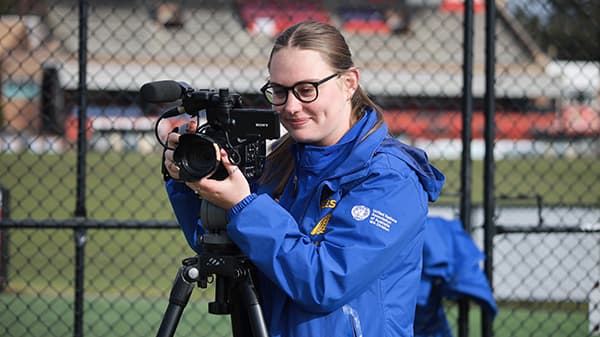
ECU's partnership with the West Coast Eagles was extremely beneficial for me
The partnership led to a six-month paid position in the media and broadcasting department at WCE. Whilst working with the club I have continued to develop my filming and editing skills which will help me in my future career. It has also helped me to build my portfolio which is critical in applying for future jobs.
Quick guide to uni-speak
-
-
The Australian Qualifications Framework (AQF) is the national regulator of qualifications in the Australian education and training system. The AQF defines the essential characteristics, including the required learning outcomes, of the different types of qualifications issued across the higher education systems in Australia.
-
ATAR is the Australian Tertiary Admission Rank, the primary criterion for entry into most undergraduate university courses in Australia. The ATAR is a percentile score which denotes a student's ranking relative to their state-wide peers upon completion of their secondary education.
-
CRICOS is the Commonwealth Register of Institutions and Courses for Overseas Students. A CRICOS code is allocated to education institutions (like ECU) who are approved to recruit, enrol and deliver education to overseas students. Courses with a CRICOS code are available to international students who meet the entry requirements.
-
A major, or unit set, is your chosen area of in-depth study in an undergraduate course. It usually involves 8 units of study, or one-third of the units in a 3-year degree. Talk to your Student Information Office if you need help choosing a major subject.
-
Minors include between 4 and 6 study units in a specific discipline. Not all courses require you to complete a minor. Your minor subject doesn't appear on your printed degree (parchment), but is part of your academic transcript.
-
If you're enrolled in 3 or more units in a semester this is considered full-time study. To complete most 3-year degrees studying full-time you'll need to complete 4 units per semester, i.e. 24 units over 3 years.
-
-
-
If a course is available to study part-time you can generally expect it to take twice as long to complete as it would in full-time mode. Part-time students are enrolled in 1 or 2 units maximum per semester.
Note: International students who hold a student visa can only choose the full-time study option for our courses. This is to ensure the course is completed within the duration of the student visa.
-
Most courses start in Semester 1 each year, usually in the last week of February. Some courses can be started in Semester 2 (we call this mid-year). There's a week of Orientation before each semester to help you get used to uni life.
-
A lot of our courses start in Semester 2 each year, usually in the last week of July. We call this mid-year. There's a week of Orientation beforehand to help you get used to uni life.
-
We use a points system to make it easier for you to understand your study progress. Most Bachelors degree study units are allocated 15 credit points. If you're studying a 3-year full-time degree you'll need to successfully complete 360 credit points - that's 24 units x 15 points per unit.
-
These are compulsory units you have to successfully complete as part of your course.
-
An elective is a unit you choose to study that counts towards your course requirements, but isn't compulsory. For some courses we recommend elective units. In some situations, a course coordinator may approve an elective unit as a replacement for a compulsory one.
-
Quick guide to uni-speak
-
-
The Australian Qualifications Framework (AQF) is the national regulator of qualifications in the Australian education and training system. The AQF defines the essential characteristics, including the required learning outcomes, of the different types of qualifications issued across the higher education systems in Australia.
-
ATAR is the Australian Tertiary Admission Rank, the primary criterion for entry into most undergraduate university courses in Australia. The ATAR is a percentile score which denotes a student's ranking relative to their state-wide peers upon completion of their secondary education.
-
CRICOS is the Commonwealth Register of Institutions and Courses for Overseas Students. A CRICOS code is allocated to education institutions (like ECU) who are approved to recruit, enrol and deliver education to overseas students. Courses with a CRICOS code are available to international students who meet the entry requirements.
-
A major, or unit set, is your chosen area of in-depth study in an undergraduate course. It usually involves 8 units of study, or one-third of the units in a 3-year degree. Talk to your Student Information Office if you need help choosing a major subject.
-
Minors include between 4 and 6 study units in a specific discipline. Not all courses require you to complete a minor. Your minor subject doesn't appear on your printed degree (parchment), but is part of your academic transcript.
-
If you're enrolled in 3 or more units in a semester this is considered full-time study. To complete most 3-year degrees studying full-time you'll need to complete 4 units per semester, i.e. 24 units over 3 years.
-
-
-
If a course is available to study part-time you can generally expect it to take twice as long to complete as it would in full-time mode. Part-time students are enrolled in 1 or 2 units maximum per semester.
Note: International students who hold a student visa can only choose the full-time study option for our courses. This is to ensure the course is completed within the duration of the student visa.
-
Most courses start in Semester 1 each year, usually in the last week of February. Some courses can be started in Semester 2 (we call this mid-year). There's a week of Orientation before each semester to help you get used to uni life.
-
A lot of our courses start in Semester 2 each year, usually in the last week of July. We call this mid-year. There's a week of Orientation beforehand to help you get used to uni life.
-
We use a points system to make it easier for you to understand your study progress. Most Bachelors degree study units are allocated 15 credit points. If you're studying a 3-year full-time degree you'll need to successfully complete 360 credit points - that's 24 units x 15 points per unit.
-
These are compulsory units you have to successfully complete as part of your course.
-
An elective is a unit you choose to study that counts towards your course requirements, but isn't compulsory. For some courses we recommend elective units. In some situations, a course coordinator may approve an elective unit as a replacement for a compulsory one.
-
Do you have any questions about the Master of News and Entertainment Media?
The Important Things
Things you should know about if you're thinking about studying here.
Course Entry
There's more than one admission pathway into an ECU course. It depends on what you've studied already, or your work or life experience.
Fees & Scholarships
Course tuition fees can change, but we can give you an estimate of your costs. If you're eligible, a scholarship or student loan can help too.
Applying
Applying for a course is a fairly simple process, especially if you have scanned copies of qualifications, your resume or other paperwork, ready to upload.
ECU Experience
Starting a course is an exciting and sometimes daunting time, so we make a massive effort to ensure you get all the support you need to have a positive experience.