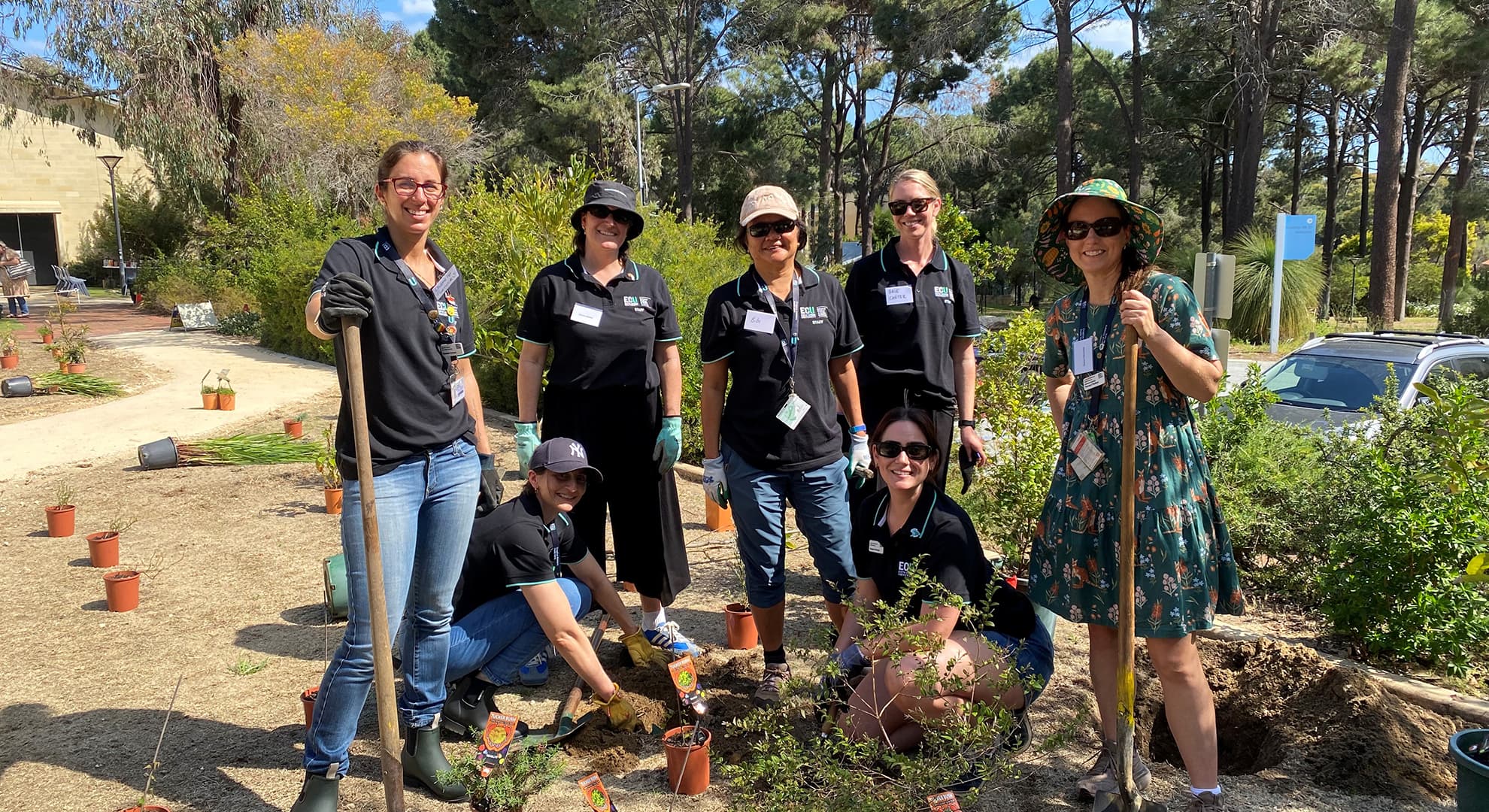
 There was no shortage of volunteers on the day.
A bush tucker garden is being planted at Edith Cowan University (ECU) by the School of Medical and Health Sciences, which is working with Campus and Environments and Tucker Bush to develop a dedicated area beside Building 17, at Joondalup Campus.
The garden will feature a wide range of edible Noongar, Western Australian and Australian native plants, with an emphasis on species that perform well in Perth's climate and those traditionally used within the southwest. Signage will include a plant description along with a QR code pointing to more detailed information on the Tucker Bush website around the plant's history, uses, fruiting and care.
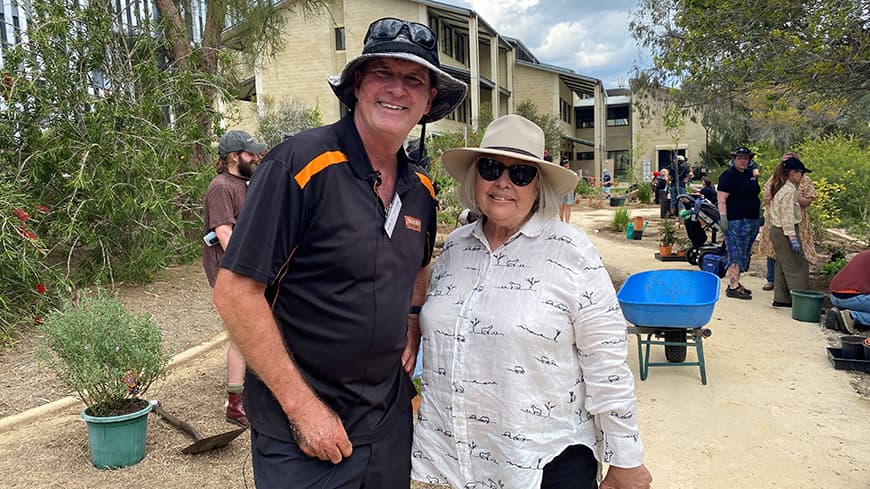 Mark Tucek and Aunty Dale Tilbrook overseeing the planting.
The idea for the garden started with the University's Nutrition and Dietetics staff participating in the 'Indigenising Curriculum' Community of Practice, facilitated by Ruby-Jean Hindley, ECU Senior Curriculum Designer.
Well-known Perth personality Mark Tucek is a champion of local horticulture and Australian native edible plants. The company, Tucker Bush, of which Mr Tucek is founder and horticulturalist, is a 51 per cent Aboriginal owned and operated enterprise, owned by Mindy Woods and Aunty Dale Tilbrook. It is dedicated to promoting Indigenous knowledge of bush tucker to kitchens across Australia. Mr Tucek has generously assisted with identifying the most suitable location and plant selection for the garden.
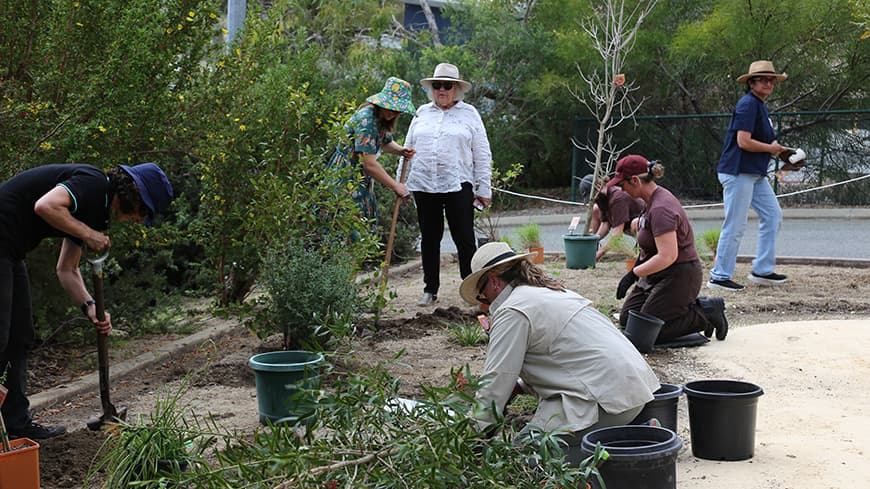 All hands on deck for the planting.
Proud Wardandi Bibbulmun Elder Dale Tilbrook, cultural director of Tucker Bush, is also taking centre stage in this initiative, giving the garden the benefit of her long experience in showcasing Australian native edible plants.
The garden forms an integral part of the Nutrition and Dietetics program, with the aim of embedding Indigenous perspectives within the curriculum. Other programs are also welcome to use the garden. Students from across the School of Medical and Health Sciences will work alongside staff to plant the garden and learn from Mr Tucek and Aunty Dale about the importance of the plants, their uses, and their cultural significance. Students will also learn about the role of Indigenous bushfoods in traditional and contemporary food systems, and how native ingredients can contribute to healthy, sustainable and culturally responsive food practices.
The garden encourages visitors to appreciate the relationship between people, plants and Country
One of the aims of the garden is to inspire people to grow Australian bushfoods themselves. Many native edible plants are surprisingly easy to grow in home gardens and can be used in everyday cooking. From herbs and leafy greens through to berries, fruits and spices, these plants bring unique Australian flavours while supporting local biodiversity and attracting birds and pollinators.
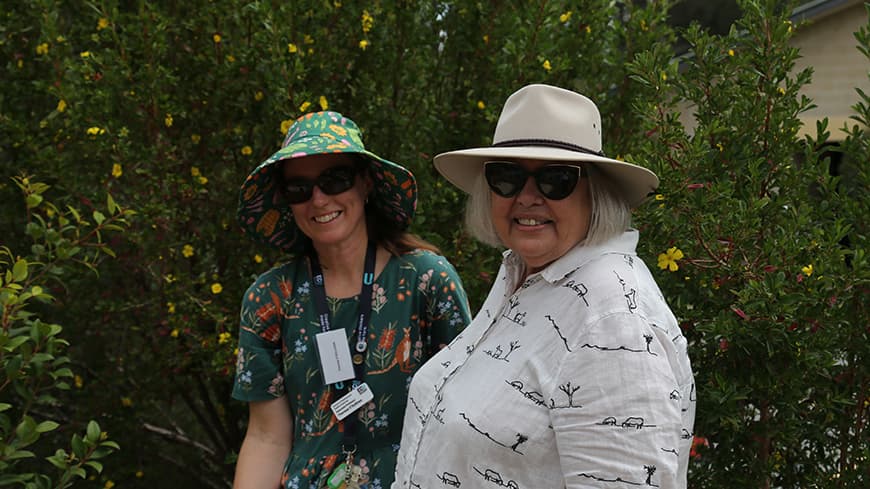 Associate Professor Therese O'Sullivan and Aunty Dale Tilbrook.
"We wanted to create an opportunity for learning experiences that celebrate Indigenous food traditions and knowledge, sustainability and connection to Country," said Associate Professor Therese O'Sullivan, from ECU's Nutrition and Health Innovation Research Institute.
The initiative formally embeds Indigenous ecological knowledge into health sciences education. By developing a dedicated learning space, ECU is looking firmly into the future, training the next generation in fostering sustainable, locally-led and scientifically supported horticultural practices.
Ms Hindley noted the work that has gone into the garden. "It's extremely gratifying to see the outcome of the conversations that occur in the Communities of Practice and I really want to applaud the team for this huge achievement."
The hope for the garden is that it will become a place where students, staff and visitors can connect with Country, learn from Indigenous knowledge systems and gain a greater appreciation for Australia's remarkable native food plants.