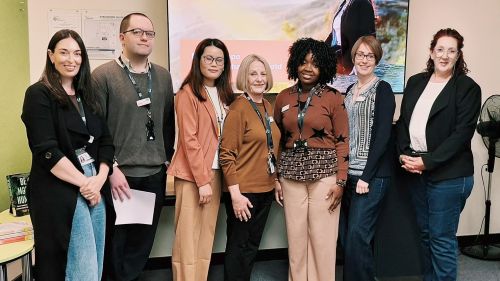
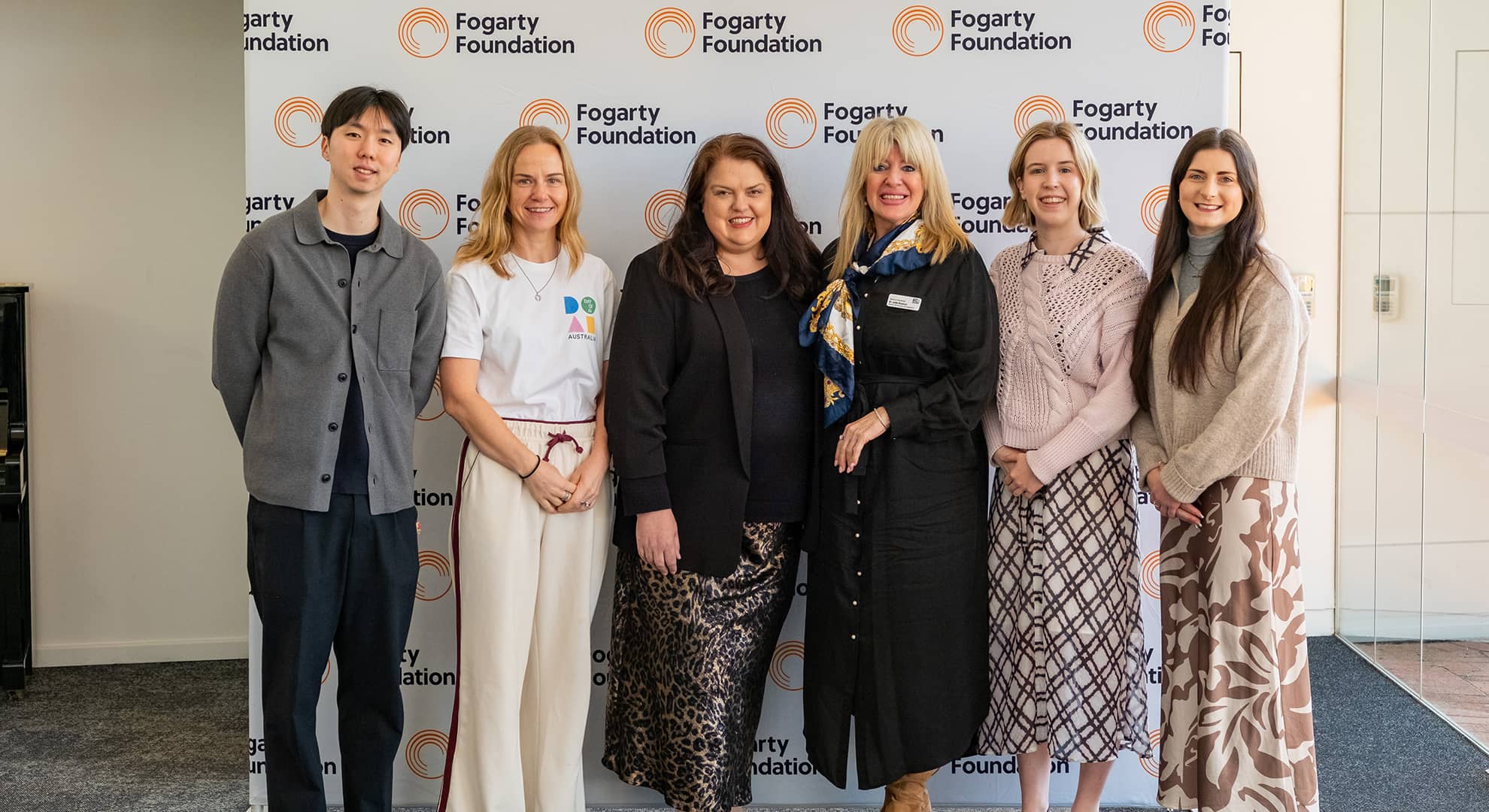
 Fogarty Program Coordinator Harry Kwon, Day of AI Australia Curriculum Specialist and Teacher Trainer Jacqueline Manison, Dr Sarah Ratner, ECU School of Education Director of Partnerships and Engagement Julie Boston, Fogarty Foundation Chief Executive Officer Elizabeth Knight and Fogarty Program and Communications Manager Laura Potts.
One of the leading voices in Artificial Intelligence (AI) and education, Oxford University post-doctoral researcher Dr Sara Ratner, has shared her insights into the ethical and effective use of AI as part of an Education Sector Leadership Think Tank event.
Hosted by the Fogarty Foundation and Forrest Research Foundation, in partnership with Edith Cowan University (ECU), Dr Ratner was the keynote speaker at the AI in Education event.
Dr Ratner, an ECU Bachelor of Education alum, leads the AI in Education at Oxford University model (AIEOU) and has contributed to the United Nations Educational, Scientific and Cultural Organization (UNESCO) AI Competency Framework for Teachers.
Hosted at ECU City and attended by high-level decision makers within Western Australia's education sector, Dr Ratner led the Think Tank with a focus on strengthening research collaboration, informing policy development, and translating AI research into teaching practice.
A part of Dr Ratner's visit, she also hosted ‘AI in Education: A Day for Pre-Service Teachers' at ECU Joondalup, which included a hands-on professional development workshop delivered by Day of AI Australia.
Key insights into AI's place in education
Findings from participatory research with multiple stakeholders, particularly teachers and students, revealed one of the main concerns regarding AI was how to ensure education remains human centred, Dr Ratner said.
"How do we promote human flourishing? And how do we keep humans at the centre of what good education is," she said.
"We did a survey of 550 stakeholders, and we asked them the most pressing questions regarding AI and education, and ultimately the key insights that came out from that were people were predominantly concerned with how we ensure education remains human centred."
A further global study revealed the predominant findings from Australian participants about AI in education was concern regarding equitable access for all learners.
Earlier this year in England, the UK Department for Education released its Gen AI product safety standards, which Dr Ratner said provided good examples of guidelines in relation to technology which has been developed for use in educational contexts.
"One of the things they said was ‘no anthropomorphizing technological tools' they use in schools," she said.
"So, students need to understand they're engaging with a computer interface, and not something that's made to look like a person, or a character or something like that.
"I think that's important because if we want to retain a human-centred approach, we must remember that this is technology using code to generate the most probable next word in a sentence.
"I think if we can remind students of that in a very visible way, then that goes a long way to retaining what is fundamentally human as well, because there is a big difference between a computer interface and what your human teacher is doing."
Dr Ratner presented the AIEOU model at the think tank, which she explained was an interdisciplinary research hub designed to bring together key stakeholders from policy, education, foundations and industry to have a shared conversation around the challenges and questions of the role AI could play in education.
Since the launch of the AIEOU model in 2024, it now has more than 4000 collaborators.
Think Tank participants were given the opportunity to critically examine the model, and other relevant frameworks or models, and draw on their own expertise and experience about what was applicable or needed adaptation, and what gaps remain for Western Australia.