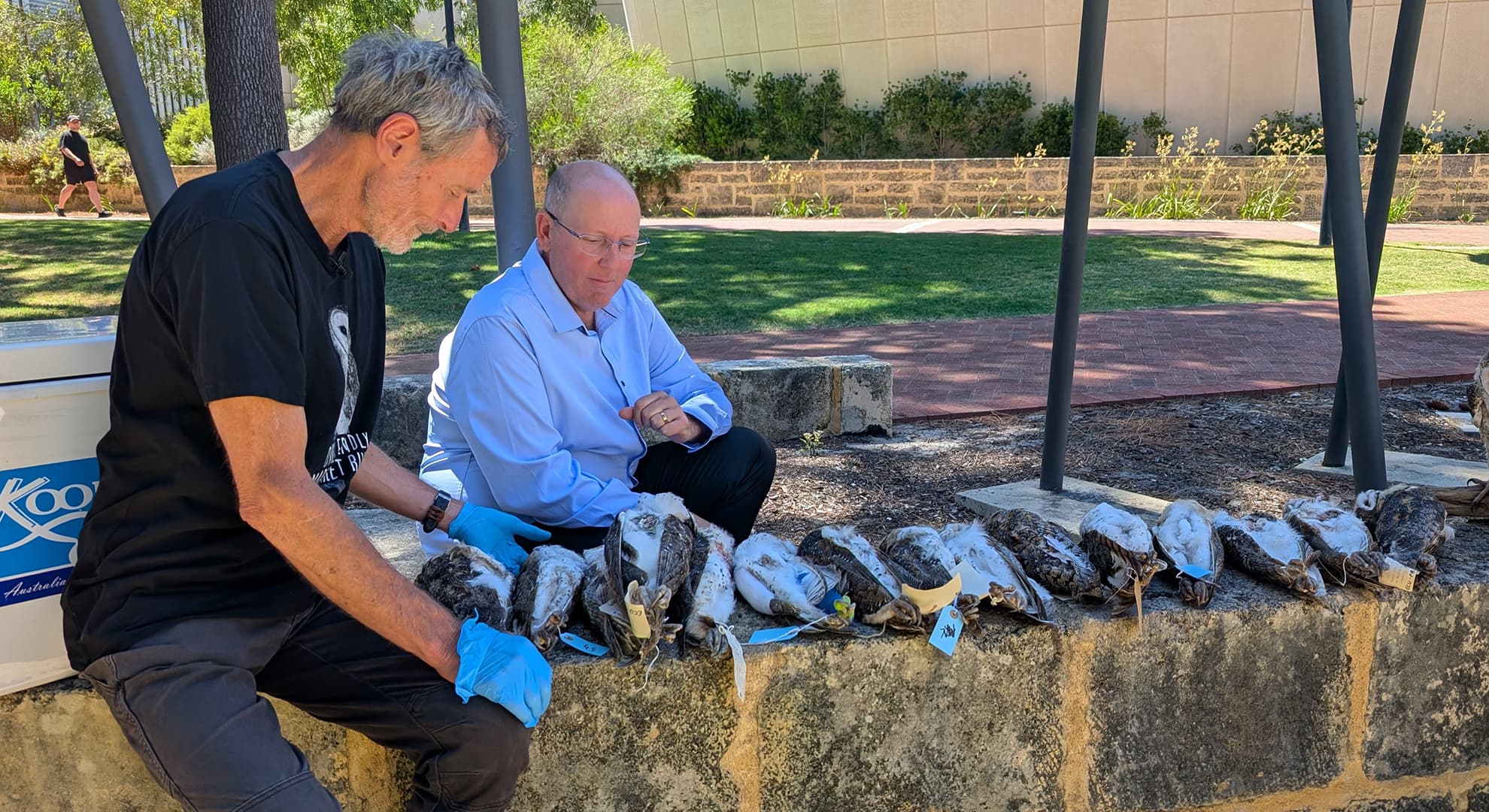
 Dr Boyd Wykes (Owl Friendly Margaret River) and ECU's Dr Robert Davis showing the deadly effect of rat poisons on Masked Owls. Credit: Karen Majer
After more than a decade of research into the impact of rat poisons on native wildlife, Associate Professor in Wildlife Conservation Robert Davis from ECU's School of Science is celebrating a decision he feared would never come.
The federal pesticides regulator, Australian Pesticides and Veterinary Medicines Authority (APVMA), has announced a ban on the sale of second-generation anticoagulant rodenticides (SGARs).
This means that some commonly used rat baits will be taken off shelves at supermarkets and hardware shops, with several major outlets already announcing their intention to halt sales.
Mining company Fortescue also looked to research pioneered by Dr Davis and his former PhD student - and now ECU Adjunct Dr Mike Lohr - in its decision to remove SGARs from its operations prior the AVPMA decision.
"It's rare in science to contribute research that ends up leading regulatory change," Dr Davis said. "I'm just happy that we could be part of the larger movement that lead to this ban."
Dr Davis said his lab began investigating the effects these baits have on native animals a decade ago when Dr Lohr – originally from Pennsylvania – raised concerns that they were readily available in Australia.
The USA banned SGARs in 2013 and they are highly restricted in many other parts of the world.
Over the years, there has been mounting evidence of the effect SGARs have on native owls, reptiles, quolls and Tasmanian Devils.
"These baits can have a devastating effect on native animals, which receive lethal or crippling doses when they eat poisoned rats and mice," Dr Davis said.
He has worked closely with conservation groups Owl Friendly Margaret River and Birdlife Australia, campaigning for local governments to phase out use of rodenticides.
In 2024, Dr Davis was part of a delegation to Parliament House in Canberra to meet with politicians and the APVMA, to present their scientific evidence.
Finally – and unexpectedly – on 10 March, 2026, the pesticides authority announced that after consulting with states and retailers, SGARs sales would be suspended for a year, with regulatory controls put in place to prevent sale to consumers. SGARs will still be available to licensed and trained pest controllers.
"This news is very welcome, however after the year-long suspension we need SGARs to be defined as a "restricted chemical product" (RCP). This means they can be removed from sale to consumers permanently, and only be accessible to commercial providers," Dr Davis said.
"The removal of these toxic rodent baits from public sale will save countless native animals from suffering and improve the outlook for many threatened species."
Read more about why SGARs are so damaging to wildlife in Dr Davis' The Conversation article.