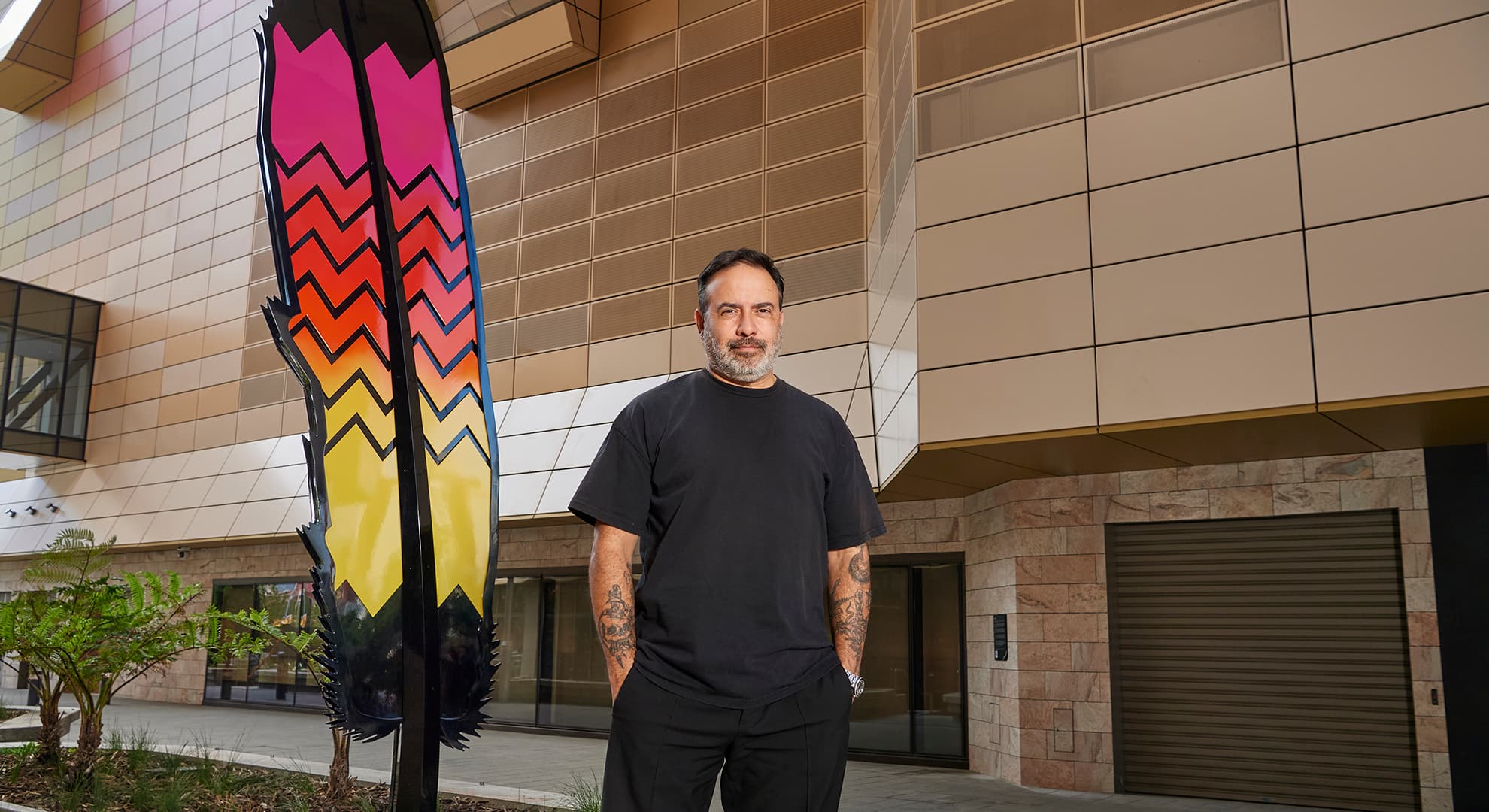
 Reko Rennie, Journey, 2026. Edith Cowan University. Photo Frances Andrijich. Courtesy Apparatus.
Edith Cowan University (ECU) has unveiled two significant public artworks at its new ECU City Campus. The works celebrate the cultural, spiritual and ecological narratives of the Noongar people of the southwest of Western Australia, with a focus on Boorloo, Perth, the place at which the ECU City Campus is located.
Jointly funded by the Australian Government, Western Australian Government and ECU, the newly opened world-class creative industries, business and technology campus will bring around 10,000 students and staff to the Perth CBD.
Located in prominent outdoor spaces at the campus, the public artworks mark a new milestone in the transformation of the precinct into a vibrant destination for learning, creativity, culture and connection.
Wadandi/Menang/Kaniyang/Goreng/Bibbulmun artist Lea Taylor has delivered an integrated artwork etched into the pavement outside the ECU City Campus, on Yagan Square.
The artwork evokes the underground waterways that continue to flow beneath Whadjuk Country. Sweeping lines trace the path of the Waagyl, the Rainbow Serpent and life-giving rainmaker, whose presence shaped the land. Circular forms represent the lakes that once sustained the Whadjuk people, nourished by the Waagyl, and which now lie hidden beneath the concrete and glass of modern Perth.
The second is a duo of large-scale sculptures by Kamilaroi artist Reko Rennie installed into Karak Walk, the laneway running between Yagan Square and Queen Street.
The large-scale sculptures draw on the tail feathers of the Karak (Red-Tailed Black Cockatoo) and the Ngoolark (Carnaby's Black Cockatoo), while also evoking Lake Goologoolup and its surrounding wetlands.
Both artists, working under the guidance of Whadjuk Elders, the traditional owners of the land the campus is on, collaborated to create these significant works.
"Today we celebrate the powerful vision of Lea Taylor and Reko Rennie, whose works bring to life the cultural and ecological stories of Boorloo. These artworks speak to enduring knowledge, culture and connection across generations, reminding us of the deep history embedded in this place," ECU Vice-Chancellor Professor Clare Pollock said.
"At ECU we are proud to host and elevate these cultural narratives within a space of learning, one that brings together past, present and future. In doing so, we honour those who have come before us, recognise the significance of truth-telling and cultural continuity, and create opportunities for our community to learn, reflect and walk forward together with respect."
Planning and Lands Minister and Perth MLA John Carey said ECU City Campus had already been a massive success for the inner-city and these artworks would add further vibrancy to the campus.
"ECU City Campus represents an $853 million investment by our State Government in partnership with the Federal Government and ECU," Mr Carey said.
"It has been a game changer for Perth, driving thousands more people into the heart of the city and spurring on a student accommodation boom.
"It's fantastic to see these works by Lea Taylor and Reko Rennie unveiled – adding to the vibrancy of the campus and reflecting the Noongar heritage of the space."
Assistant Minister to the Prime Minister and Member for Perth MP Patrick Gorman said ECU City is already bringing more life and foot traffic to the heart of the city, with this artwork adding even more vibrancy and cultural significance.
"I have long supported this campus as a place to bring students to enrich their entire learning experience. Today we deliver on an important part of that vision," Mr Gorman said.
"Lea Taylor and Reko Rennie's artworks are a new landmark for our city. Now students, locals and visitors alike are able to enjoy the story of Boorloo's rich, 50,000-year cultural history. Extending learning beyond the classroom for students who value education, culture, art, and community. Grounding the trailblazers of the future in the story of our city's past."
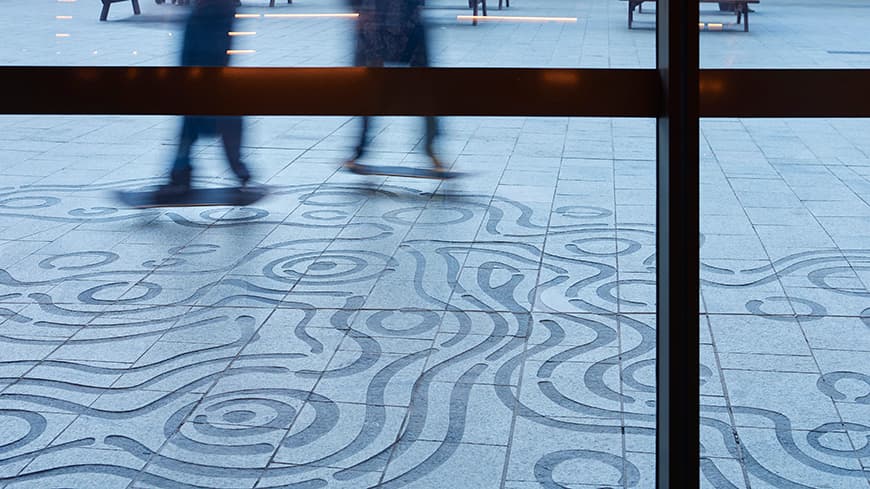 Lea Taylor, Kep Koorliny Djenna Bidi (Water Moving Walking Trail), 2026. Edith Cowan University. Photo Frances Andrijich. Courtesy Apparatus.
Tradition at its foundations
The ECU City Campus is located on one of a series of resource-rich, connected waterways, known as a place of inter-generational sharing and learning for the Whadjuk Noongar people – traditional custodians of Boorloo, Perth and the surrounding areas.
From the earliest planning stages, Whadjuk Noongar Elders worked alongside ECU to ensure the City Campus respects that history, while also creating a place for future generations to learn, gather and thrive.
ECU Deputy Vice-Chancellor (Students and Education), Professor Braden Hill said public artworks like these can help create shared spaces for dialogue, understanding and respect, contributing to a future grounded in recognition and truth.
"Public artworks like these remind us that education does not only happen in classrooms or lecture theatres, but also in public places, through encounters, story and reflection. At ECU, this commitment to truth-telling, cultural respect and creative expression is central to who we are."