
 Composer Liza Lim's "The Oresteia", libretto Barrie Kosky
New Music can be baffling, noisy, delicate, thrilling – and sometimes all at once. WAAPA Associate Professor Jonathan W Marshall offers a guide to opening your ears to Perth's most adventurous sounds.
If you are lucky enough to be invited to a gig mounted by, say, Sage "Pbbbt" Harlow – a local vocalist who does not sing words and draws on both Tuvan throat singing and death metal – or to attend something equally out of the ordinary, consider the following principles as a guide into the world of weird and wonderful sounds.
Is it interesting?
Outsiders often ask if I actually enjoy listening to something like Dale Gorfinkel's absurdist percussion set from the 2023 Fremantle Biennale. I respond: do you really enjoy watching a film about death and failure like Dunkirk (2017)? There are many reasons to sit through something. The first thing to remember is that New Music artists may not be aiming to entertain you with catchy tunes, but rather to provoke sensations and thoughts about sounds and how they fit together. This can be enjoyable – or not!
Music for the "astonished ear"
Electronic music pioneer François Bayle said that he made music for the "astonished ear", and consequently produced music that surprised the listener. Especially within electronic music, carefully crafted sounds that are deliberately odd – long shattering echoes, strange twists and wipes, scintillating patterns – all feature in contemporary New Music. So listen for erratic changes and surprises, whether they are made by electronic or acoustic instruments. Decibel's performance of Lionel Marchetti's work, for example, was a fantastically varied mix of electronics and acoustic sound.
Listen for texture
Most conventional Western music is governed by a beat or pulse (rhythm), the layering of notes to produce chords and harmonies, and the succession of musical ideas (a tune or melody).
Texture, however, is the interaction of notes, musical lines, microtones and granular elements to produce aural surfaces and distinctive sound qualities. Listening for texture is often central to New Music.
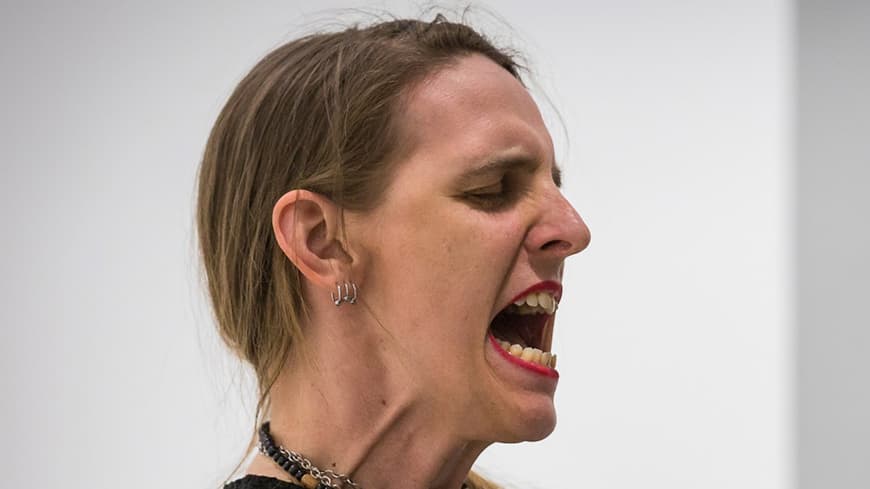 Sage "Pbbt" Harlow. Image courtesy WAAPA.
The Art Of Noises
You may also find that there is no discernible rhythm or harmony, only noisy dissonances. This is what sound art pioneer Luigi Russolo called the "Art of Noises". Think of the screeching guitar solos of Jimi Hendrix, except here the feedback itself is the focus.
Russolo's contention that otherwise rejected everyday or industrial sounds might be worth listening to led to the subgenre of Noise Music, epitomised by Lucas Abela, who plays distorted, amplified sheets of glass – yes, that is what he plays.
The cornerstones of New Music, therefore, are the variation of textures over time and the highlighting of particularised, distinctive and out-of-the-ordinary sonic qualities.
Repetition is OK too
Do not, however, expect all New Music to be squealing, jagged, plinkety-plonk music. Sometimes little changes over time, and you may hear the same passage or tone repeated again and again. Today, few composers advocate only repeated minimalist phrases, but there remains a tendency to move between densely packed, highly active sounds – consider Aaron Cassidy's 27 Juni 2009 – and sparse repetitions and slow developments. David Chesworth's "Wallpaper Music" and his Badlands Suite are good examples of minimalist repetition.
Making it up & extended techniques
The trends described above emerged from punk and DIY music, as well as from responses to the dominance of dissonant atonalism within Western art music. Free jazz and improvisation, however, were also important.
Wilder jazz improvisers insisted that which notes followed which was a purely intuitive matter: a will-o'-the-wisp translation of unrepeatable impulses into sounds that might not have any obvious association with tone, harmony or other constraints.
Artists began experimenting with unconventional ways of playing, such as jettisoning the saxophone's mouthpiece to produce metallic clatters, squeaks and bonks. Australia's master of abstract saxophone is Jim Denley, who has collaborated with others such as Matthias Schack-Arnott, who constructs novel percussive instruments. Here, DIY constructions, art music and free intuitions combine. This can sometimes be loud, but also very quiet, the idea being to attune to the delicacy of each musical gesture. Somewhere between loud and soft are Pateras/Baxter/Brown.
All responses are worth considering
Above all, do not be intimidated by New Music. You hated it! You loved it! It baffled you! Great. These are all valid responses.
Just as there is no such thing as a good or bad sound – only a sound you want to listen to, or not – the principles of New Music are rubbery, personal and variable. So go out and listen to everything from Liza Lim’s currently showing eerie opera The Oresteia to the crushing electronica of the 2023 ATOTAL tour. New Music today can be so free and variable that there is something for everyone.
Perth New Music organisations
The main organisations in Perth that program music similar to what I describe are:
- Tura New Music: New Music pioneers in Perth, now often focused on developing new works and First Nations collaborations, while still regularly programming great new shows.
- Tone List: representing newer generations, as well as promoting concerts and music, Tone List is committed to music and the arts as diverse and welcoming practices. It is associated with regular independent programs such as Outcome Unknown, Audible Edge, Goolugatup Sounds, and more.
- Noizemaschin!!: founded to support DIY electronics workshops, while also mounting wild, typically loud shows.
- Perth Festival and PICA (Perth Institute of Contemporary Arts) help bring polished interstate works to Perth, although Perth Festival can still be a tad square – for example, programming very straight UK pastoralism by Vaughan Williams and Benjamin Britten in 2023.
- The Ellington: devoted to melodic, modal or conventional jazz, The Ellington nevertheless sometimes programs free improvisation.
This article was originally published in SeeSaw Magazine.