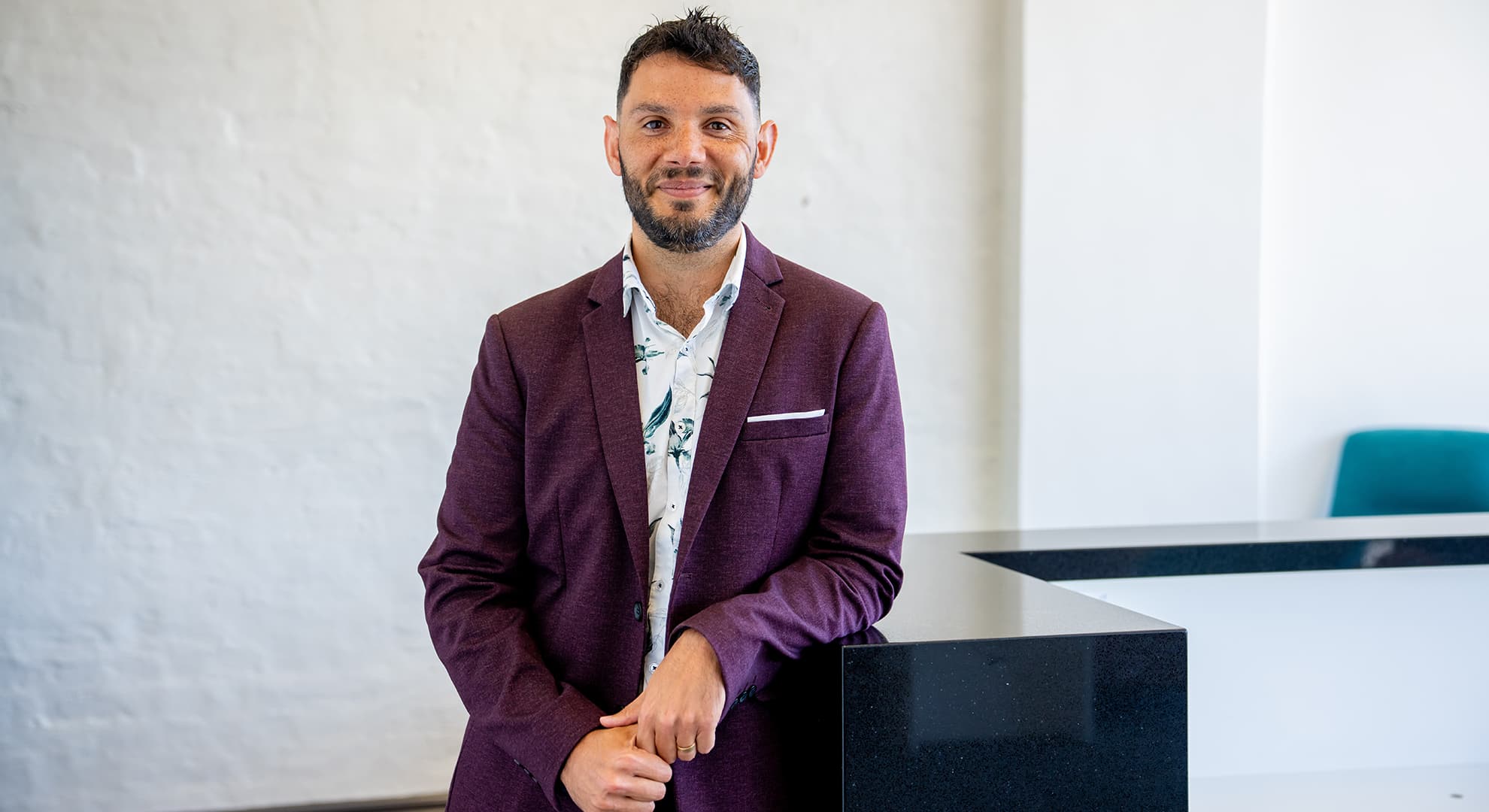
 Professor Braden Hill.
For many Aboriginal and Torres Strait Islander people, racism and disrespect are not rare or exceptional experiences. They are part of an endured everyday life, encountered in workplaces, public spaces, institutions, and online. But the alleged attempted terrorist attack at the Invasion Day rally in Perth has added an unsettling fear, that racial hatred and resentment have reached a point where some are willing to consider seriously harming members of our community, and those who stand alongside us.
In my reflecting on this feeling, I came to the recognition that this fear is not entirely new. It is an old one, deeply rooted in our shared history, but one that has re-emerged in a contemporary form, carried by new rhetoric and new platforms.
I reflected on the harm done to the Jewish community in Bondi who continue to feel the shock, fear, and vulnerability that such acts of violence create – again a fear that is not new and, for some, has never gone away. I also carry ongoing empathy for Palestinian civilians in Gaza, especially children and families, who continue to endure devastating loss and trauma.
Holding compassion for some does not diminish care for others and empathy is not a zero-sum equation; holding care for one community does not require withholding care from another. If anything, these moments ask more of us, to widen our circle of concern and to insist on the full humanity of people – even those we may never meet.
I reflect on these communities also because of my work connected to the Racism@Uni Study.
This week, the Australian Human Rights Commission released the Racism@Uni findings, a national study examining the prevalence and impact of racism across Australian higher education. The study speaks to patterns of harm that are experienced in distinct ways, and it underscores that Aboriginal and Torres Strait Islander, Jewish, and Palestinian people are especially exposed to racism, discrimination, and hostility within university settings. Of course, these findings do not exist in isolation. They mirror broader social pressures, while also challenging us locally to do more, with greater urgency, consistency, and care.
Universities sit at a critical intersection as places of learning but also places where we bring difference together, surface contested histories and ask difficult questions. That work is essential, but it also means we cannot pretend that broader social fractures stop at the campus boundary.
In an age shaped by AI and the easy drift toward surface-level engagement, our educational work has to do more than transmit information. It must strengthen human connection and help people stay present with complexity, listen across difference, and practise the skills of respectful disagreement. More than ever, universities must be places where learning is not only about content, but also about relationship, sensemaking, and belonging, because respect is not built by algorithms. It is built when people choose to stay in connection, to keep listening, to keep learning, even when it is difficult, and even when life is messy.
This is why the Curriculum Transformation Project is about much more than assessment security. It is about protecting, enabling, and renewing the human relationships at the centre of education, trust, dialogue, feedback, accountability, and growth. To do this well, our work as a university must also be to remove the barriers that prevent students and staff from fully engaging in this labour, whether those barriers are cost-of-living pressures, caring responsibilities, accessibility needs, or other structural obstacles to participation and success. Only then can people truly immerse themselves in this demanding, meaningful, and deeply human work.
In the face of rising division and hate, universities have a responsibility to hold the line on connection, on truth-telling, and on the slow, relational work that keeps people human to one another. Education at its best does not simply prepare people for work or assessment. It helps them stay in relationship with complexity, with difference, and with each other. In the spirit of our namesake, we know that work is not easy, but it is essential, and it is worth protecting.
- ECU encourages any students who are experiencing distress to seek support through ECU Health and Wellbeing Services, which provide confidential advice and care.
- Staff who may be affected are also encouraged to access support through the University's Employee Assistance Program.
News & Opinion articles:
- NIT (Renae Isaacs-Guthrudge), Mon 19 Jan: January 26 and Australia s selective grief
- NIT (Renae Isaacs-Guthridge), Wed 28 Jan: 'We deserve the same Australia other Australians receive when they face threats'
- Crikey, Thurs 29 Jan: The muted response to the Perth bombing exposes a pattern of national indifference
- Crikey, Tue 3 Feb: As a rally organiser, the Boorloo bombing has triggered a series of 'what ifs
- The Conversation, Thurs 5 Feb: Why did it take 9 days to declare the Perth bombing attempt a terrorist attack?
- ABC, Sat 7 Feb: Elders say truth-telling 'critical' to combatting racism after alleged terror attack
- NIT, Mon 9 Feb: McCarthy raises First Nations racism concerns as NIAA to attend Royal Commission meetings
- NIT, Tue 10 Feb: Government pressed to expand royal commission terms of reference after alleged terror attack
Resources & Support:
- Grief, loss and trauma – Australian Indigenous HealthInfoNet
- There s nothing casual about racism – AHRC
- What is Racism? And does it still exist in Australia? Amnesty International
- Racism in Australia ANTAR
- Rethinking our national holiday ANTAR
- Why is racism a problem? AHRC
- Dismantling systemic racism – perspectives from First Nations people AHRC
- 2024 Australian Reconciliation Barometer: Racism and First Nations People Reconciliation Australia