 Close-up of liquid being poured in flask
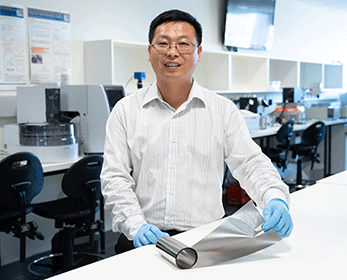
It may look like a simple piece of aluminium foil, but when added to wastewater this high-tech strip of iron can remove impurities like dyes and heavy metals in just minutes.
Researchers at Edith Cowan University have found a way to modify the internal structure of iron-based alloy to develop a new type of crystalline alloy capable of stripping contaminants like heavy metals, dyes and other organic pollutants from wastewater.
Lead Researcher, Professor Laichang Zhang from ECU's School of Engineering, said the technology could have significant applications in the textile and mining industries.
"Mining and textile production creates huge amounts of wastewater that is contaminated with heavy metals and dyes," he said.
 One tonne of wastewater can be treated for just $15.
 The crystalline alloy can be re-used up to 5 times.
Cost-effective solution
"We can produce enough crystalline alloy to treat one tonne of wastewater for just $15. Additionally, we can reuse the crystalline alloy up to five times, while still maintaining its effectiveness."
This offers significant advantages to the traditional method of treating wastewater using commercial iron powder.
"Firstly, using iron powder leaves you with a large amount of iron sludge that must be stored. Secondly, it is expensive to produce and can only be used once," Professor Zhang said.
Reordering structure
Professor Zhang said the crystalline alloy was based on his previous work developing metallic glasses.
"Whereas metallic glasses have a disordered atomic structure, the crystalline alloy we have developed has a more ordered atomic structure," he said.
"We produced the crystalline alloy by heating metallic glass in a specific way.
This modifies the structure, allowing the electrons in the crystalline alloy to move more freely, thereby improving its ability to bind with dye molecules or heavy metals leaving behind useable water".
Professor Zhang said he was now working with partners in industry to further improve the efficiency and reduce the cost of producing the crystalline alloy.
'Compelling Rejuvenated Catalytic Performance in Metallic Glasses' was published in the journal Advanced Materials.