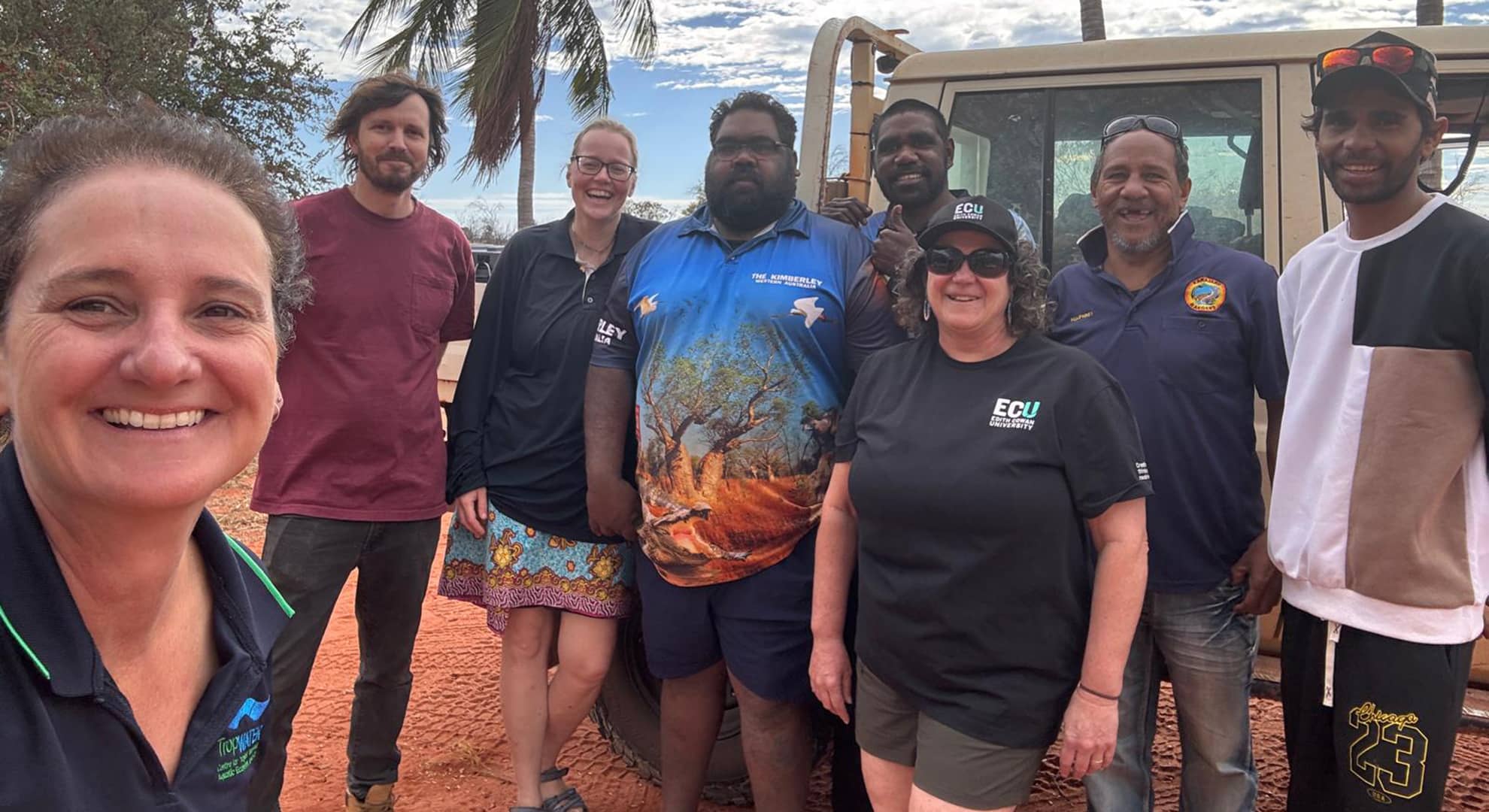
 Dr Catherine Collier (JCU), Sam Frederick (Film maker), Dr Ankje Frouws (ECU), Kelvin Mitchelson (Karajarri Ranger Coordinator), Andre Kitty (Karajarri Ranger), Professor Kathryn McMahon (ECU), Jason Dean (Karajarri Ranger Coordinator), Chipper Taylor (Karajarri Ranger). Credit: Catherine Collier.
Indigenous Rangers and researchers from Edith Cowan University have co-designed practical guides to give Rangers the skills they need to lead seagrass monitoring across northern Australia's vast tropical meadows.
Launched on World Ranger Day (31st July), the new toolkit provides step-by-step videos and manuals for Rangers monitoring seagrass - building on long-standing partnerships that are supporting Rangers from Western Australia to Queensland, including the Torres Strait, to care for Sea Country.
Rangers from Karajarri Traditional Lands Association in northern Western Australia, Namultja Aboriginal Corporation in the Northern Territory, the Torres Strait Regional Authority and Girringun Aboriginal Corporation in Queensland partnered with researchers from James Cook University TropWATER, Charles Darwin University's Northern Institute, and Edith Cowan University to create the new monitoring resources.
The toolkit empowers Ranger groups to lead monitoring using a set of consistent, tried-and-true methods – opening opportunities for sharing knowledge and tracking changes in seagrass health across northern Australia.
Professor Kathryn McMahon, Co-Director for Centre for People, Place and Planet from ECU's School of Science, said seagrass meadows are vital habitats for culturally and ecologically important species including dugongs, turtles, fish, and invertebrates – but climate change impacts, extreme weather events, and coastal development are putting seagrasses under increasing pressure.
"These videos, co-designed with Karajarri Rangers and seagrass scientists are a fantastic resource to guide monitoring of sea country and train up the next generation of Rangers," Professor McMahon said.
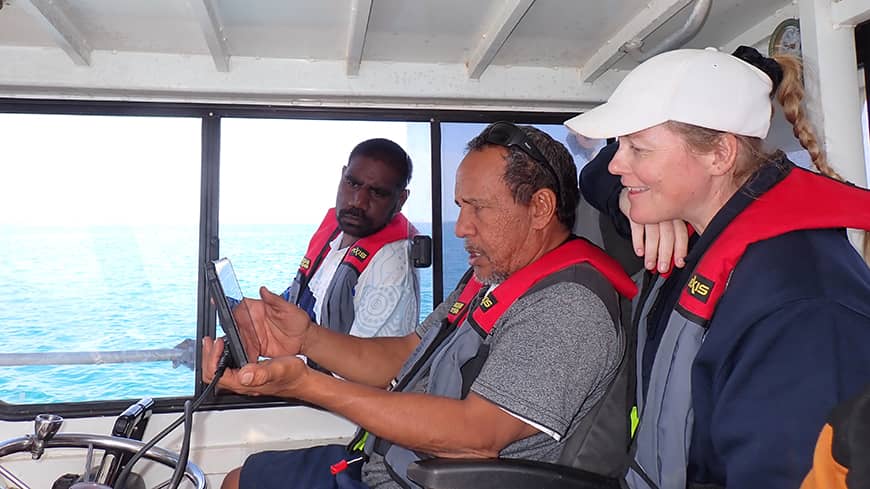 Dr Ankje Frouws from ECU with Karajarri Rangers Andre Kitty and Jason Dean. Credit: Kathryn McMahon.
Dr Ankje Frouws, Postdoctoral Research Fellow at ECU's School of Science, said the videos showcase monitoring techniques already tried and tested by Indigenous Ranger groups in remote conditions, making them well-suited for adoption by other groups facing similar challenges.
"Northern Australia's coastline is vast and remote, making regular monitoring of its coastal ecosystems challenging," Dr Frouws said. "Indigenous communities have deep cultural and spiritual ties to Sea Country, placing them in a unique position to monitor these ecosystems.
"Only through consistent, long-term monitoring can we understand how coastal ecosystems are tracking, and respond quickly if something goes wrong.
"The monitoring videos show approaches tailored to different seagrass conditions depending on local conditions, such as walking transects for intertidal meadows, drones for larger or harder-to-reach shallow areas, and boat-deployed drop cameras for deeper, subtidal meadows."
Each video in the toolkit blends training with local connection, featuring Rangers and Traditional Owners reflecting on how they are working to protect their Sea Country and why seagrass monitoring matters to them.
"If we didn't have any seagrass there would be no turtle or dugong," Karajarri Elder Faye Dean said. "I don't think people realise how important seagrass is."
The project was supported with funding from the Australian Government under the National Environmental Science Program, with additional support from the Torres Strait Regional Authority, Namultja Aboriginal Corporation, Karajarri Traditional Lands Association, Girringun Aboriginal Corporation, Northern Territory Government and Great Barrier Reef Foundation.
Take a look at the work with Karajarri here: Karajarri Sea Country Seagrass Monitoring
Further videos and information are available on the project page: National Environmental Science Program
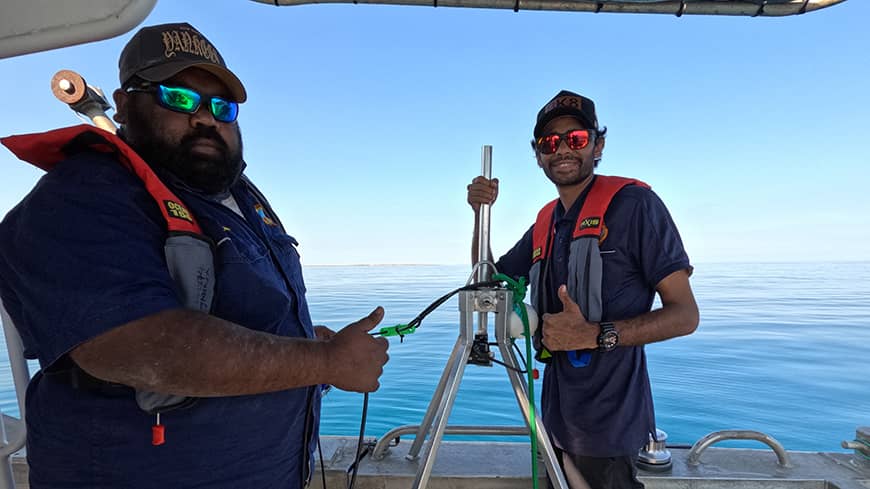 Karajarri Rangers Kelvin Mitchelson and Chipper Taylor. Credit: Ankje Frouws.
Regional highlights
Karajarri Sea Country, Western Australia
- Seagrass monitoring by Karajarri Rangers and researchers began in 2024.
- Over 190km2 of seagrass has been mapped in Karajarri Sea Country since monitoring began, growing from around 4 metres water depth down to 32 metres and including six seagrass species.
- Karajarri Rangers and researchers visited 347 sites by boat and 1,123 sites by helicopter in 2024-25.
- Surveys found large, previously unknown areas of seagrass and other biodiverse seafloor habitats including macroalgae, hard coral, and soft coral such as gorgonians and sea whips.
- Long-term Ranger-led monitoring is needed to understand how a shifting climate may impact these important dugong and turtle habitats.