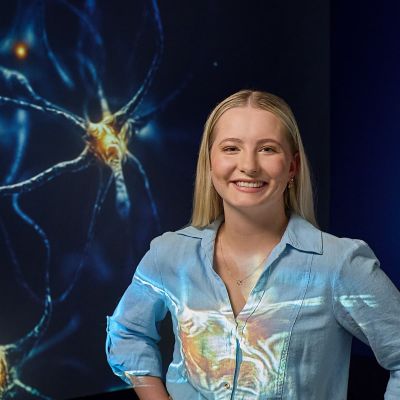
Graduate Certificate in Neurological Rehabilitation
Course code J92
This course extends the skills and knowledge of health and exercise professionals currently working with individuals with a range of neurological conditions.
Students will develop an understanding of how research findings and current guidelines, along with their client's values and preferences and their own clinical experience, can be incorporated into effective, evidence informed, management.
The program is open to a range of professionals including practising Speech Pathologists, Occupational Therapists, Physiotherapists, Exercise Physiologists, and Registered Nurses wanting to expand their knowledge in the area of neurological rehabilitation.
The course is available online, and students have the opportunity to progress their studies further and move into a Graduate Diploma and then Master of Neurological Rehabilitation to further explore implementation science research avenues.
Entry requirements
ECU admission and English language requirements apply.
See Course Entry for further information.
Course code
J92
Admissions
Fees
Domestic fee paying - estimated 1st year indicative fee AUD $11,150
See Fees and Scholarships for further information.
Availability & Campus
| JO | ML | BU | OL | |
|---|---|---|---|---|
| Full-time | ||||
| Part-time |
See Course Details for further information.
Entry requirements
ECU admission and English language requirements apply.
See Course Entry for further information.
Course code
J92
Fees
See Fees and Scholarships for further information.
Availability & Campus
| JO | ML | BU | OL | |
|---|---|---|---|---|
| Full-time | ||||
| Part-time |
See Course Details for further information.
Course Entry
Admission requirements you'll need to meet for this course.
-
The following course-specific admission requirements are mandatory and must be satisfied by all applicants. These requirements are in addition to or supersede the minimum requirements outlined within the Academic admission requirements band section below.
All applicants are required to be a registered health professional i.e. Occupational Therapist, Physiotherapist, Rehabilitation Nurse, Medical Practitioner, or be graduates from a nationally-professionally accredited program (e.g., Speech Pathologist, Dietitian, Exercise Physiologist). All applicants must maintain this registration/professional accreditation for the duration of this course, and have a minimum of one year full time (or equivalent) clinical experience in a relevant area of clinical practice and have worked with clients with neurological conditions undergoing rehabilitation.
Academic admission requirements (Band 6) may be satisfied through completion of one of the following:
- Bachelor degree; or
- Equivalent prior learning including at least five years relevant professional experience.
-
English competency requirements may be satisfied through completion of one of the following:
- IELTS Academic Overall band minimum score of 6.5 (no individual band less than 6.0);
- Bachelor degree from a country specified on the English Proficiency Bands page;
- Successfully completed 0.375 EFTSL of study at postgraduate level or higher at an Australian higher education provider (or equivalent);
- Where accepted, equivalent prior learning, including at least five years relevant professional experience; or
- Other tests, courses or programs defined on the English Proficiency Bands page.
Course Details
Choose student typeSemester availability
Semester 1: Study full-time Online
Semester 1: Study part-time Online
Semester 2: Study full-time Online
Semester 2: Study part-time Online
Semester availability
Semester 1: Study full-time Online
Semester 1: Study part-time Online
Semester 2: Study full-time Online
Semester 2: Study part-time Online
This course is not offered for study on-campus to international students with a student visa.
Course Structure
J92|1
For more detailed unit information for this course take a look at our Handbook. To organise your life for next semester visit the Semester timetable.
Student handbookCourse notes
Important course notes
Course Learning Outcomes
- Apply cognitive, technical and creative skills to investigate, evaluate and synthesise complex neurological concepts and theories in clinical rehabilitation situations.
- Demonstrate the use of effective communication skills to impart research findings and best practice evidence to clinical rehabilitation situations.
- Reflect critically on a complex body of neurological knowledge, contemporary research and best-practice to demonstrate mastery of neurological rehabilitation professional practice.
Fees and Scholarships
Choose student typeAUD $11,150 *
* Domestic fee paying - estimated 1st year indicative fee
The 'Estimated 1st year indicative fee' is provided as a guide only, based on a typical enrolment of students undertaking the first year of this course. At ECU, you pay for the individual units you enrol in, not an overall course fee, so the total cost of your course will vary, depending on what units you choose. An indicative fee will be provided with your course offer, however you can use our Course Fee Calculator to estimate the amount you’ll need to pay. ECU fees are adjusted annually.
Scholarships
ECU has a scholarship program that provides many opportunities each year to students undertaking studies here.
Find a scholarshipCareer Opportunities
This program of study will support career progression for individuals within their clinical roles (for instance to more senior roles), or may encourage clinicians to move from clinical practice to research/education or academic positions (after completing the Grad Diploma and Masters). There is a great need for clinical researcher roles to be developed within many health services. Graduates of this program will be well-equipped to undertake such roles.
Courses you can consider if you are interested in progressing further in this area.
Student
stories
"The knowledge I have learned has really improved my capabilities and I have noticed a confidence in my practice"
I am currently working in physiotherapy and wanted to specialise in neurological rehabilitation. I chose ECU as it was the only university in WA offering postgrad studies designed for increasing knowledge in neurological rehabilitation.
I am enjoying studying online and the weekly modules are motivating. The content is relevant and thought provoking, and there are are plenty of opportunities to collaborate with peers using the discussion board.
The knowledge I have learned has really improved my capabilities and I have noticed a confidence in my practice.
Quick guide to uni-speak
-
-
ATAR is the Australian Tertiary Admission Rank, the primary criterion for entry into most undergraduate university courses in Australia. The ATAR is a percentile score which denotes a student's ranking relative to their state-wide peers upon completion of their secondary education.
-
CRICOS is the Commonwealth Register of Institutions and Courses for Overseas Students. A CRICOS code is allocated to education institutions (like ECU) who are approved to recruit, enrol and deliver education to overseas students. Courses with a CRICOS code are available to international students who meet the entry requirements.
-
A major, or unit set, is your chosen area of in-depth study in an undergraduate course. It usually involves 8 units of study, or one-third of the units in a 3-year degree. Talk to your Student Information Office if you need help choosing a major subject.
-
Minors include between 4 and 6 study units in a specific discipline. Not all courses require you to complete a minor. Your minor subject doesn't appear on your printed degree (parchment), but is part of your academic transcript.
-
If you're enrolled in 3 or more units in a semester this is considered full-time study. To complete most 3-year degrees studying full-time you'll need to complete 4 units per semester, i.e. 24 units over 3 years.
-
If a course is available to study part-time you can generally expect it to take twice as long to complete as it would in full-time mode. Part-time students are enrolled in 1 or 2 units maximum per semester.
Note: International students who hold a student visa can only choose the full-time study option for our courses. This is to ensure the course is completed within the duration of the student visa.
-
-
-
Most courses start in Semester 1 each year, usually in the last week of February. Some courses can be started in Semester 2 (we call this mid-year). There's a week of Orientation before each semester to help you get used to uni life.
-
A lot of our courses start in Semester 2 each year, usually in the last week of July. We call this mid-year. There's a week of Orientation beforehand to help you get used to uni life.
-
We use a points system to make it easier for you to understand your study progress. Most Bachelors degree study units are allocated 15 credit points. If you're studying a 3-year full-time degree you'll need to successfully complete 360 credit points – that's 24 units x 15 points per unit.
-
These are compulsory units you have to successfully complete as part of your course.
-
An elective is a unit you choose to study that counts towards your course requirements, but isn't compulsory. For some courses we recommend elective units. In some situations, a course coordinator may approve an elective unit as a replacement for a compulsory one.
-