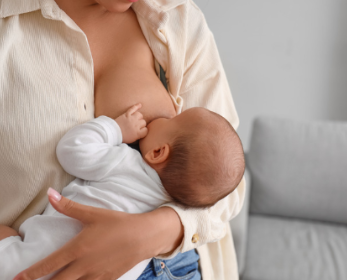
Breastfeeding is considered the ‘gold standard’ in infant nutrition with a plethora of health benefits for both the infant and mother.1-4
Initiation rates for breastfeeding at birth in Australia are high at 96%, however, by hospital discharge, exclusive breastfeeding rates decline to 71%.5,6 One of the barriers to exclusive or any breastfeeding in the early postpartum period is the presence of nipple pain and trauma. Australian studies have reported the phenomenon of nipple pain to be anywhere from 36-79%, with nipple trauma between 58-62%.7-9
Correct positioning and attachment at the breast are considered a first-line method in preventing pain and trauma.10,11
Whilst a Cochrane’s 2014 systematic review and meta-analysis found limited evidence to recommend any intervention for nipple pain treatment other than expressed breastmilk there was an insufficient number of studies of low level laser therapy (LLLT) to be included at the time of synthesis.12
Over the last 10 years, the use of LLLT in the treatment of nipple pain and trauma has internationally increased, particularly in countries such as Brazil.13-16 It is postulated that LLLT operates at a cellular level, triggering photochemical reactions to stimulate tissue repair, decrease local inflammation, and modulate nerve conduction to mitigate pain.17-19
In Australia, one case series looking into LLLT treatment at the Mater Hospital (QLD) has been reported,20 with King Edward Memorial Hospital (WA) currently the only public facility continually utilising LLLT for nipple pain and trauma, circumstantially reporting positive outcomes. A recent meta-analysis from Brazil suggested LLLT to be a promising mode of treatment, however further larger studies are needed to confirm the efficacy, safety, and strategies to best address heterogeneity of treatment parameters.21
The use of LLLT as an intervention to positively improve early breastfeeding postpartum outcomes is in its infancy in Australia. A large RCT is urgently needed to provide evidence and also reassurance to breastfeeding mothers suffering from nipple pain and trauma, that LLLT may assist them to continue their breastfeeding journey, thus providing healthier long-term outcomes for mother and baby.
Authors
Tegan Chapman, RN, CM, IBCLC, Hons, MPhil, Women’s and Children’s Hospital, Adelaide, South Australia
Professor Mary Steen, OBE RGN RM BHSc PGCRM PGCert MWSDP, PGDipMH PGDipHE MCGI PhD, Professor of Maternal and Family Health, Edith Cowan University (ECU), Perth Western Australia.
References
- Victora CG, Bahl R, Barros AJD, França GVA, Horton S, Krasevec J, et al. Breastfeeding in the 21st century: epidemiology, mechanisms, and lifelong effect. Lancet Lond Engl. 2016 Jan 30;387(10017):475–90. doi:10.1016/S01406736(15)01024-7 PubMed PMID: 26869575.
- Camacho-Morales A, Caba M, García-Juárez M, CabaFlores MD, Viveros-Contreras R, Martínez-Valenzuela C. Breastfeeding contributes to physiological immune programming in the newborn. Front Pediatr. 2021;9:744104. doi:10.3389/fped.2021.744104 PubMed PMID: 34746058; PubMed Central PMCID: PMC8567139.
- Patnode CD, Henrikson NB, Webber EM, Blasi PR, Senger CA, Guirguis-Blake JM. Breastfeeding and health outcomes for infants and children: A systematic review. Pediatrics. 2025 Jul 1;156(1):e2025071516. doi:10.1542/peds.2025-071516 PubMed PMID: 40240318.
- Rameez RM, Sadana D, Kaur S, Ahmed T, Patel J, Khan MS, et al. Association of maternal lactation with diabetes and hypertension: A systematic review and meta-analysis. JAMA Netw Open. 2019 Oct 2;2(10):e1913401. doi:10.1001/ jamanetworkopen.2019.13401 PubMed PMID: 31617928; PubMed Central PMCID: PMC6806428.
- Australian Institute of Health and Welfare [Internet]. 2011 [cited 2026 Jun 13]. 2010 Australian national infant feeding survey: indicator results, Summary. Available from: https:// www.aihw.gov.au/reports/mothers-babies/2010-australiannational-infant-feeding-survey/summary
- Meedya S, Hocking J, Atchan M, Burns E. Publicly available Australian hospital data on infant feeding: A review and comparative analysis of outcomes. Women Birth. 2024 Sep;37(5):101658. doi:10.1016/j.wombi.2024.101658
- Buck ML, Amir LH, Cullinane M, Donath SM, for the CASTLE Study Team. Nipple pain, damage, and vasospasm in the first 8 weeks postpartum. Breastfeed Med. 2014 Mar 1;9(2):56–62. doi:10.1089/bfm.2013.0106
- Kent J, Ashton E, Hardwick C, Rowan M, Chia E, Fairclough K, et al. Nipple pain in breastfeeding mothers: Incidence, causes and treatments. Int J Environ Res Public Health. 2015 Sep 29;12(10):12247–63. doi:10.3390/ijerph121012247
- Thompson R, Kruske S, Barclay L, Linden K, Gao Y, Kildea S. Potential predictors of nipple trauma from an in-home breastfeeding programme: A cross-sectional study. Women Birth. 2016 Aug;29(4):336–44. doi:10.1016/j.wombi.2016.01.002
- Douglas P. Re-thinking lactation-related nipple pain and damage. Womens Health. 2022 Jan;18:17455057221087865. doi:10.1177/17455057221087865
- Wang Z, Liu Q, Min L, Mao X. The effectiveness of the laid-back position on lactation-related nipple problems and comfort: a meta-analysis. BMC Pregnancy Childbirth. 2021 Dec;21(1):248. doi:10.1186/s12884-021-03714-8
- Dennis CL, Jackson K, Watson J. Interventions for treating painful nipples among breastfeeding women. Cochrane Pregnancy and Childbirth Group, editor. Cochrane Database Syst Rev. 2014 Dec 15;2014(12). doi:10.1002/14651858.CD007366. pub
- Elseody MHAA, Mohamed MAER, Alsharnoubi J. Could photobiomodulation help lactating women and their newborns? Lasers Med Sci. 2024 Jul 24;39(1):192. doi:10.1007/ s10103-024-04132-w
- Coca KP, Marcacine KO, Gamba MA, Corrêa L, Aranha ACC, Abrão ACFDV. Efficacy of Low-Level Laser Therapy in relieving nipple pain in breastfeeding women: a tripleblind, randomized, controlled trial. Pain Manag Nurs. 2016 Aug;17(4):281–9. doi:10.1016/j. pmn.2016.05.003
- Camargo BTS, Coca KP, Amir LH, Corrêa L, Aranha ACC, Marcacine KO, et al. The effect of a single irradiation of low-level laser on nipple pain in breastfeeding women: a randomized controlled trial. Lasers Med Sci. 2020 Feb;35(1):639. doi:10.1007/s10103-019-02786-5
- Gaitero MV, Mira TA, Gondim EJ, Gonçalves AV, Nascimento SL, Surita FG. Low-level laser therapy for breastfeeding women with nipple pain in the early postpartum period: a r. J of Maternal-Fetal Neonatal Med. 2026;39(1). doi:doi.org/10.1080/1 4767058.2026.2636360
- Mosca RC, Ong AA, Albasha O, Bass K, Arany P. Photobiomodulation therapy for wound care: a potent, noninvasive, photoceutical approach. Adv Skin Wound Care. 2019 Apr;32(4):157–67. doi:10.1097/01. ASW.0000553600.97572.d2 PubMed PMID: 30889017.
- Farivar S, Malekshahabi T, Shiari R. Biological effects of Low Level Laser Therapy. Vol. 5. 2014;5(2).
- Fulop AM, Dhimmer S, Deluca JR, Johanson DD, Lenz RV, Patel KB, et al. A meta-analysis of the efficacy of laser phototherapy on pain relief. Clin J Pain. 2010 Oct;26(8):729–36. doi:10.1097/ AJP.0b013e3181f09713
- Ralph M, Hurst C, Guyatt S, Goldsmith K, Laakso EL. In postnatal women with nipple pain, does photobiomodulation therapy (PBMT) at 660 nm compared with sham PBMT reduce pain on breastfeeding? A case series during COVID-19. Laser Ther. 2023 Apr 18;30(1). doi:10.4081/ltj.2023.315
- De Oliveira Alves R, Faccioli Ragghianti MH, Nunes LP, Ferreira MF, Alves De Toledo PT, Ferrisse TM, et al. Photobiomodulation as a promising approach in the management of nipple lesions during breastfeeding: a systematic review and metaanalysis of randomized clinical trials. Lasers Med Sci. 2025 Jun 12;40(1):276. doi:10.1007/s10103025-04531-7