Top of page

Student/Staff Portal
Global Site Navigation

About ECU

Local Section Navigation
You are here: Main Content

Cultural reflection spaces

Edith Cowan University (ECU) acknowledges and respects its continuing association with the Noongar People, the Traditional Custodians of the lands upon which its campuses stand. Furthermore, we respect and acknowledge all our Aboriginal and Torres Strait Islander graduates and staff who come from many nations across Australia.

Learn more about our commitment to Indigenous Australians

Aboriginal and Torres Strait Islander peoples are advised this resource may contain images or names or references to people who have passed on.

NAIDOC Week

In celebration of NAIDOC Week 2026, and its theme 50 Years of Deadly, ECU is proud to share the university’s Cultural Reflection Spaces across our Joondalup and South West campuses.

50 Years of Deadly marks an important milestone in the NAIDOC movement, celebrating five decades of Indigenous voices, culture and resilience. ECU honours past and present Kurongkurl Katitjin staff, Elders, artists, cultural advisors, and the many contributors who have collaborated to share, shape and enrich these Cultural Reflection Spaces.

ECU’s Reconciliation Plans were the catalyst to the Cultural Reflection Spaces project. Today, there are six spaces at the Joondalup Campus and one at the South West Campus, each offering an opportunity to connect with Noongar culture, knowledge, Country and reflection.

During NAIDOC Week and beyond, ECU warmly invites staff, students, alumni and the wider community to explore these spaces and spend time at them across our campuses.

Explore the Cultural Reflection Spaces on campus

Take a self-guided journey of the Cultural Reflection Spaces at ECU. Visit each space at your own pace your own pace. Invite a colleague or friend or take a walk on our own.

Download the maps below to begin exploring the Cultural Reflection Spaces. At each location, scan the QR code on the map to learn more about the space.

Joondalup Campus

Location: Building 1

Along the pathways, visitors are welcomed by the words Wanjoo (the Noongar word for ‘Welcome’) and Welcome, a greeting that acknowledges and embraces all who enter the space. Flowing across the three pathways, coloured weave patterns reflect the direction of the south-west winds, symbolising the traditional use of smoke in Aboriginal culture to welcome, cleanse and protect both people and place.

For Aboriginal and Torres Strait Islander peoples , smoke holds deep cultural significance. It is used in ceremony to cleanse an area, dispel negative spirits and invite positive energy. This symbolism is echoed through the use of native plantings, including balga trees, Coastal Daisy and saltbush. Their soft, smoky-grey foliage evokes the cleansing smoke used in traditional Welcome to Country ceremonies, creating a landscape that reflects connection, healing and cultural respect.

The space also includes a seating area, allowing small groups of visitors to be welcomed in a more formal way.

Ready to step into the space?

Walk through and notice the details that shape its meaning. Watch the Welcome to Place video.

Location: Graduation Square behind Building 1

The Rock Solid Foundations Tribute was unveiled on 28 November 2011 at the ECU’s Mount Lawley Campus on the lawn in front of Kurongkurl Katitjin. Its unveiling also marked the 60th anniversary of ECU’s first Aboriginal graduate, Len Hayward, who became the first Aboriginal person to complete formal teacher training in Western Australia, graduating from Claremont Teachers’ College in 1951.

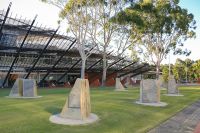
The tribute recognises and honours the strength, knowledge and resilience of ECU Aboriginal and Torres Strait Islander alumni between 1950 – 2020 and consists of seven granite stones, or pillars, honouring the Noongar story of the Seven Sisters constellation.

Each pillar of the tribute represents a ten-year block and acknowledges the names of each identified student by the year of their first graduation. Names are colour-coded according to discipline or area of study.

Following the closure of the Mount Lawley Campus, the tribute was relocated to the Joondalup Campus, ensuring its ongoing and presence and significance within the ECU community.

Interested in learning more?

Explore the following resources:

Watch the Rock Solid Foundations video.

Location: Lake and boardwalk

The Natural Elements Cultural Reflection Space is located around the man-made lake area at the centre of the Joondalup campus and was officially opened in 2016.

The space was designed to enrich the campus experience by creating a deeper connection to the surrounding landscape and the journey people take through it. It was also designed to be a place for relaxation and studying and reflect upon Aboriginal Noongar seasons Birak, Bunura, Djeran, Makuru, Djilba and Kambarang.

The design represents five natural elements, expressed using Noongar language:

  1. Kaarla (fire)
  2. Boya (stone) – the earth
  3. Boorn (wood)
  4. Maam (wind)
  5. Keip (water)

Each element is expressed through carefully designed features within the space. A low red bench symbolises fire, while limestone rocks represent earth. The timber walkway embodies wood, leading visitors toward the lake while remaining open to the movement of the wind. Along the water’s edge, reflections and interpretive descriptions evoke the element of water, creating a strong connection between the landscape and its meaning.

These elements are embedded in permanent built forms, reflecting their enduring significance and lasting connection to Country. The space represents a collaborative vision, bringing Aboriginal and non-Aboriginal people together to create a place of shared understanding and cultural connection for generations to come.

Ready to explore?

Take a walk and see if you can find each of the five elements. Watch the Natural Elements video.

Location: Building 21

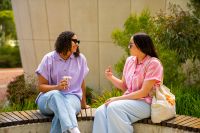
The Health and Wellness Garden at the Joondalup Campus was established as a medicinal garden, traditionally known as a physic garden, focused on the cultivation of plants used for healing and wellbeing.

The space offers an opportunity to explore and reflect on Aboriginal knowledge of natural healing, including the traditional use of native plants for medicine, nourishment and bush tucker.

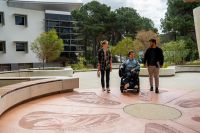
At the entrance to the garden, a central paving node features etched artwork reflecting the six Noongar seasons:

  1. Mukuru – Fertility
  2. Djilba – Incubation
  3. Kambarang – Birth
  4. Birak – Youth
  5. Bunuru – Adolescent
  6. Djeran - Adulthood

Throughout the space, raised planter walls with in-built seating form six spaces or rooms. Each of these represents one of the Aboriginal Noongar seasons and showcases native plants used in Aboriginal medicine for food and wellbeing.

Step into garden and explore each space

Take time to learn, reflect and discover how these plants support health and wellbeing.

Location: Building 31 near the flagpoles

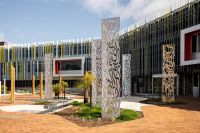
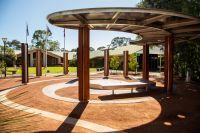
The Boorna Baronga Cultural Reflection Space at the Joondalup Campus serves as a space to welcome everyone who passes through the area.

Across Noongar Country in the south-west, plants, animals and knowledge systems are interconnected, all grounded in Boodja  (Country). There are 14 Noongar clans that make up the Noongar Nation, each holding distinct stories, languages and ways of sharing knowledge, while remaining connected as part of a broader cultural landscape.

Boorna Baronga was created to reflect these nuances and connections as you travel throughout Noongar Country.

The space recognises the different clan groups and provides an inclusive environment that welcomes everyone. In Noongar language:

  • Boorna (wood or timber trees)
  • Baronga (means totems)

At the heart of the space are 14 engraved totem poles, each representing the Noongar language groups that make up the Noongar Nation:

  1. Amangu
  2. Ballardong
  3. Yuat
  4. Kaniyang
  5. Koreng
  6. Minang
  7. Njakinjaki
  8. Njunga
  9. Pibelmen
  10. Pindjarup
  11. Wardani
  12. Whadjuk
  13. Wiilman
  14. Wudjari

The 2018 National NAIDOC Week theme ‘Because of her, we can!’ enriched the space through artworks by seven Noongar women artists – Wendy Hayden, Melissa Spillman, Cassie Jetta, Deborah Newenham, Turid Calgaret, Esther McDowell Yabini Kickett and Francine Kickett. These designs were carved into the timber poles by wood artist Tom De Munk Kerkmeer, bringing stories and cultural reflection to life.

In addition to the totem poles, boomerang shaped seating with jarrah inserts reflects the location of Whadjuk Country. Many of the seats face each another, encouraging people to come together, share a waangkiny (conversation), and learn from each other.

The plantings throughout the forecourt reflect the natural landscape character of ECU’s Joondalup Campus and the wider Swan Coastal Plain. Central to the design is the balga, a culturally significant plant for the Noongar Nation. The presence of balga is a strong marker of Noongar Country, as it does not naturally grow beyond this region, reinforcing a deep connection between the landscape and Country.

Landscape artists worked with different iconography symbols, including travel lines through the forecourt, some of which already existed on site. The design focused on reinforcing the travel lines, so they converge from both sides, guiding people toward the fire pit . This meeting point represents a place where parties can gather around the kaarla (fire).

Fire holds deep cultural significance, providing warmth and light, while its smoke helps keep away flies and insects. Traditionally, fire also serves as a place for cooking and gathering. Beyond its practical uses, fire represents an important connection between the physical and spiritual worlds.

Importantly, fire is also a symbol of inclusivity, belonging and community. When visitors were welcomed into camp, they were invited to place wood on the fire. Through this shared act, they became part of the camp, connected through conversation, storytelling and the collective experience around the fire.

Ready to take a moment?

Invite a couple of people, walk the pathways, sit, reflect and share waangkiny (conversation) as you connect with the stories and communities represented here.  Watch the Boorna Baronga video.
Location: Building 34

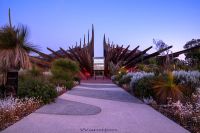
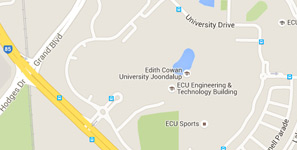
Ngoolark Cultural Reflection Space encompasses the entirety of Building 34 at the Joondalup Campus and takes its name from the Ngoolark (Carnaby’s Black Cockatoo), an endangered species native to south-west Western Australian. The building stands as a powerful expression of Noongar culture, knowledge and connection, embedded through its design.

Ngoolark is home to Kurongkurl Katitjin, a Noongar phrase meaning “coming together to learn.” It also accommodates a range of other university functions.

More than a building, Ngoolark is a meeting place, a landscape and a symbol, designed to represent the Country on which it stands.

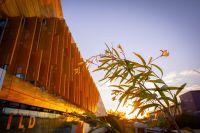
The architectural design reflects the strength and resilience of Noongar culture. Its distinctive golden sun-shading façade echoes the striking plumage of the Carnaby Black Cockatoo, with feather-like patterns repeated throughout the building, from exterior treatments to interior finishes.

The design also draws on other native species, including the Bindi Bindi (double-spotted line blue butterfly) and Jingee (honeyeater), creating a layered cultural narrative expressed through form, texture and patterns.

The five-level structure is wrapped in a gold perforated aluminium veil, providing sun protection while creating a dynamic, ever-changing façade. The exterior patterns are inspired by the chest feathers of the Carnaby’s black cockatoo.

Key cultural elements include:

  • Ngoolark (the building itself): Expressed through façade and interior detailing, including custom carpet patterns inspired by the cockatoo’s feathers.
  • Jingee: Referencing the honeyeater and connecting to ECU’s former Mount Lawley campus (Jinjeejerdeup - place of the honeyeaters), expressed through internal glass patterns.
  • Bindi Bindi: Symbolising transformation, reflected through patterned timber finishes in selected meeting spaces.
  • Joondal: Reflecting Joondalup as “a place of shimmering or glistening water”, expressed through paving patterns and connections to nearby Lake Joondalup.
  • Narla Karla: Meaning “our fire/our home,” represented in student support spaces and courtyard areas through language and fire-inspired design.

At ground level, the meandering podium landscape reflects natural forms such as billabongs and creeks. Gently undulating paving evokes a seasonal riverbed, while openings above allow light and airflow to filter through, softening the environment and nurturing the surrounding landscape. Sculptural concrete seating, inspired by tree trunks and boulders, invites people to pause and gather.

Step inside and experience Ngoolark

Notice the patterns, the light and the stories that surround you and discover how culture is woven into every part of the space.

Learn more about the artwork installed outside the Library and the Student Hub.

Watch the Ngoolark video.

South West Campus

Location: Kulbardi Court, outside Building 3 near the flagpoles

Dambart Bilya Cultural Reflection Space is located at the South West Campus.

The name Dambart Bilya, means three rivers, symbolises the meeting of the Brunswick, Collie and Preston Rivers, into Bunbury’s Koombana Bay.

The space reflects the natural and cultural elements of the Bunbury region and recognises and Wardandi Noongar Nation as the traditional custodians of the land on which the campus is situated.

Dambart Bilya is a place for rest, quiet reflection, learning and reconciliation. It is also a reminder of the natural beauty and richness of the place and its cultural heritage.

Cultural elements include six poles representing the six Noongar seasons. The poles are made from jarrah, tuart and marri reflecting the main boorna (wood) sources from the area.

Three seats, shaped like karlie/kylie (boomerangs), provides a place for rest and reflection, while also symbolising the three rivers.

The fire pit reflects the spirit woman’s campfire in the sky, and the wooden poles reflect her camp shelter.

A canopy surrounds the campfire seating area, featuring drilled patterns that reflect celestial constellations. These designs symbolise the dreaming stories that connect ECU’s three campuses through Joondal, the Milky Way, reinforcing the enduring relationship between Country, culture, and the night sky.

Ready to step into the space?

Take a moment to pause, walk the pathways, sit, and reflect as you connect with the stories, waterways and cultural knowledge held within this space.

Watch the Dambart Bilya video.

Image gallery

  • Boorna Baronga Cultural Reflection Space structure on the Joondalup Campus
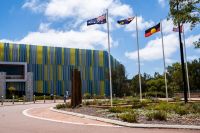
  • Three flag poles, part of the Boorna Baronga Cultural Reflection Space at the Joondalup Campus
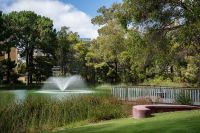
  • Lake and Cultural Reflection Space seating on the ECU Joondalup campus
  • External view of the Ngoolark building at sunset.
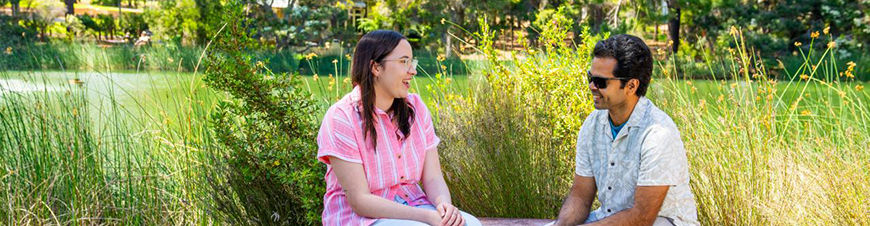
  • Two women sitting in the Health and Wellness Garden at the Joondalup Campus
  • Rock formation cultural reflection space outside Building 1 ECU Joondalup.
  • Three people entering the Health and Wellness Garden at the Joondalup Campus.
  • Dambart Bilya Cultural Reflection Space structure at the South West Campus.
  • Pathway with coloured weave patterns leading to Building 1, ECU Joondalup Campus.

ECU Cultural Reflection Spaces contributors

The Cultural Reflection Spaces would not of have been possible without the generous contributions, knowledge and support of many individuals and communities. Their guidance, collaboration and shared knowledge have shaped these spaces, ensuring they reflect culture, connection, and community for generations to come.

Skip to top of page