Top of page

Student/Staff Portal
Global Site Navigation

School of Science

Local Section Navigation
You are here: Main Content

Research

At the Centre for Artificial Intelligence and Machine Learning (CAIML), research focuses on advancing human–AI collaboration, particularly in complex environments that feature uncertainty. A key priority is developing intelligent systems that are transparent, trustworthy, and aligned with human thinking, drawing on insights from cognitive science and neuroscience.

CAIML explores areas such as machine reasoning, artificial empathy, and theory of mind in AI, helping systems better interpret and respond to human behaviour. This work underpins two core research themes:

This theme explores how AI can support decision-making under uncertainty and enable coordinated action between humans and intelligent systems.

Key areas include:

Human–AI Collaboration in Strategy and Wargaming 
Developing AI tools to model complex scenarios and optimise strategies across multi-domain operations. This includes simulating adversarial conditions, multi-agent interactions, and adaptive planning in contested environments.

Human–Robot Interaction and Intuitive Control 
Designing natural and effective ways for humans to interact with intelligent systems. Research includes language-based navigation, gesture-driven communication, and advanced robotic control in uncertain or constrained environments.

Together, these areas aim to create seamless, intuitive collaboration between humans and machines, enabling informed, timely responses in rapidly evolving situations.
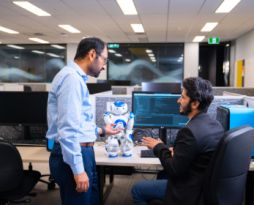
This theme focuses on how AI can interpret and make sense of complex, real-world data from multiple sources. Researchers develop advanced machine learning techniques to extract meaningful insights that support situational awareness and decision-making.

Key areas include:

Image and Vision Analysis 
Using computer vision and deep learning to interpret visual data across applications such as medical imaging, remote sensing (including aerial, satellite, and underwater environments), and multimodal data integration (combining image, audio, and video).

Anomaly Detection 
Identifying unusual patterns or behaviours in dynamic environments. Applications include cyber security (network intrusion detection), maritime monitoring (vessel behaviour analysis), and human safety (driver impairment detection).

These capabilities enable accurate, real-time understanding of complex environments, supporting both operational decisions and long-term planning.

Skip to top of page